Cheat sheet: Associate – Foundations
Everything worth holding in your head the hour before the exam, on one page. Facts come from the official exam guide; the rules of thumb are the maintainer's, distilled from the official rationales.
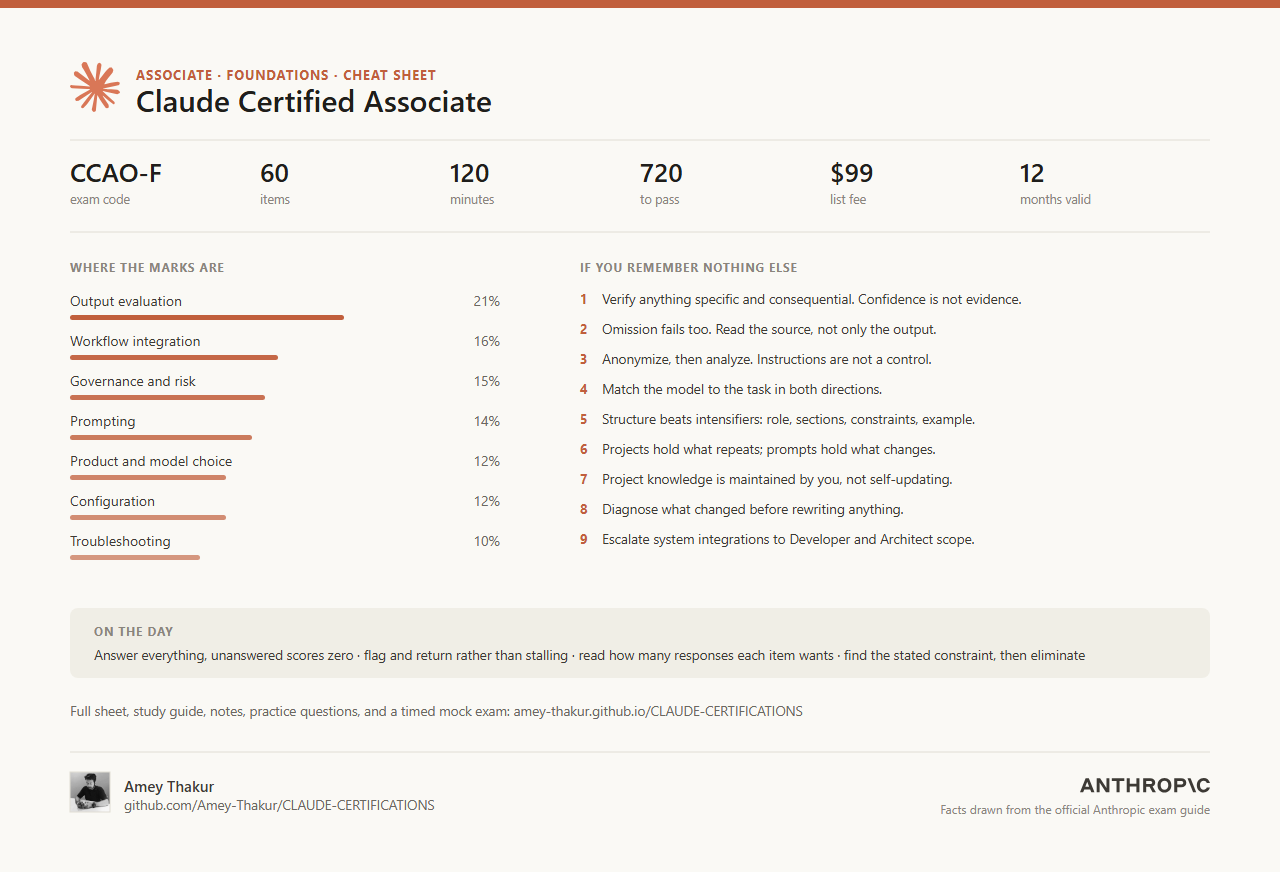
Save or share the card above; the full sheet follows.
The exam
| Code | CCAO-F |
| Items | 60, multiple choice and multiple response |
| Time | 120 minutes, about 2 minutes per item |
| Pass | 720 of 1,000, scaled |
| Fee | 99 USD before partner discount |
| Valid | 12 months, free renewal assessment |
Where the marks are
Output Evaluation and Validation      21%  ████████████████████
Workflow Integration and Design       16%  ███████████████
Governance, Risk, Responsible Use     15%  ██████████████
Prompting and Task Execution          14%  █████████████
Product and Model Selection           12%  ███████████
Configuration and Knowledge Mgmt      12%  ███████████
Troubleshooting and Optimization      10%  █████████
Evaluating output is worth half again as much as writing prompts. Study accordingly.
If you remember nothing else
- Verify anything specific and consequential. Citations, numbers, dates, and section references are where models fabricate. Confidence is not evidence.
- Self-reported confidence proves nothing. Asking the model how sure it is never validates a claim.
- Omission counts as failure. A summary that drops a material caveat is wrong even though every word in it is true. Read the source, not just the output.
- Anonymize, then analyze. Strip regulated identifiers before upload. Purpose, seniority of the requester, and "tell it to ignore that column" are not controls.
- Match the model to the task. Fast and cheap for routine volume, capable for genuine reasoning. Defaulting to the largest model is a wrong answer; so is using the smallest for hard work.
- Structure beats intensifiers. Role, audience, sections, constraints, and an example fix bad output. "Be detailed and thorough" does not.
- Decompose compound requests. Ask for the categorized list, then the top three, then the actions. One vague mega-prompt yields vague output.
- Projects hold what repeats. Durable instructions and knowledge live in the Project; per-message specifics live in the prompt.
- Project knowledge is maintained by you. Stale uploaded documents produce confidently outdated answers. Replace, do not accumulate.
- Diagnose the change. When quality drops, ask what changed (new knowledge, new sources, new prompt) before rewriting anything.
- Escalate integrations. Connecting Claude to internal systems is Developer and Architect territory. Knowing that boundary is tested.
- Answer the business question. "Can Claude do X?" is answered with a division of labor: what it drafts, what humans judge, and where the review step sits.
Judgment patterns the exam rewards
| Situation | Right instinct |
|---|---|
| Output bound for a customer, executive, or regulator | Verify claims, then human review |
| High volume, low complexity | Cheaper, faster model |
| Sensitive data in the input | Remove or pseudonymize first |
| Same task every month | Project with instructions and knowledge |
| Output format keeps missing | State the format explicitly, with an example |
| Something worked and now does not | Find the change before changing anything |
Working the clock
60 items in 120 minutes is two minutes each, and you will not need two minutes for most of them. My approach:
- First pass, about 70 minutes. Answer everything you know. If an item needs more than 90 seconds of thought, choose your best option, flag it, and move. An unanswered item scores zero; a flagged guess is a free option to change your mind.
- Second pass, about 30 minutes. Only the flagged ones. You will find that several are now obvious, because later items remind you of the framing.
- Last 20 minutes. Re-read the multiple-response items specifically. They are where careless marks are lost, because it is easy to select two when the item says three.
Reading a question the way it is written
Every scenario names a constraint: cost, privacy, speed, policy, or scale. Find that constraint first, then eliminate every option that does not address it. Two options usually survive; the better one is the one that changes the system rather than compensating around it.
When two options both look right, ask which one a careful professional would defend in front of the person who owns the risk. That is nearly always the intended answer.
The morning of
- Run the system test again on the exam machine, even if it passed last week
- Close everything on the shutdown list before check-in, not during it
- Have the ID ready, room clear, desk clear, second monitor unplugged
- Check-in takes longer than you expect; start the process early
- Eat something. 135 minutes of seat time is longer than it sounds
If you blank
Skip it and keep moving. The blueprint is finite and the items are independent; one hard question costs one mark, and stalling on it costs five. Come back in the second pass and the answer is often obvious.
Exam day logistics
- ID name must match your registration exactly
- Closed book. No notes, no documentation, no translation tools, no second monitor
- Answer everything; unanswered scores zero. Flag and return rather than stalling
- Multiple response items say how many to pick. Read that line first
- Two minutes per item is the budget
Traps
- The longest option is not the safest one; the exam rewards the option that meets the stated constraint
- "Do nothing" and "abandon the task" are almost always wrong when a compliant path exists
- Adding a disclaimer does not make inaccurate content acceptable
- A larger model is not a fix for a governance, format, or process problem
Facts last verified against the official sources on 2026-09-16. Study guide · Notes · Practice questions · Mock exam · Repository index