Cheat sheet: Architect – Foundations
Everything worth holding in your head the hour before the exam, on one page. Facts come from the official exam guide; the rules of thumb are the maintainer's, distilled from the official rationales.
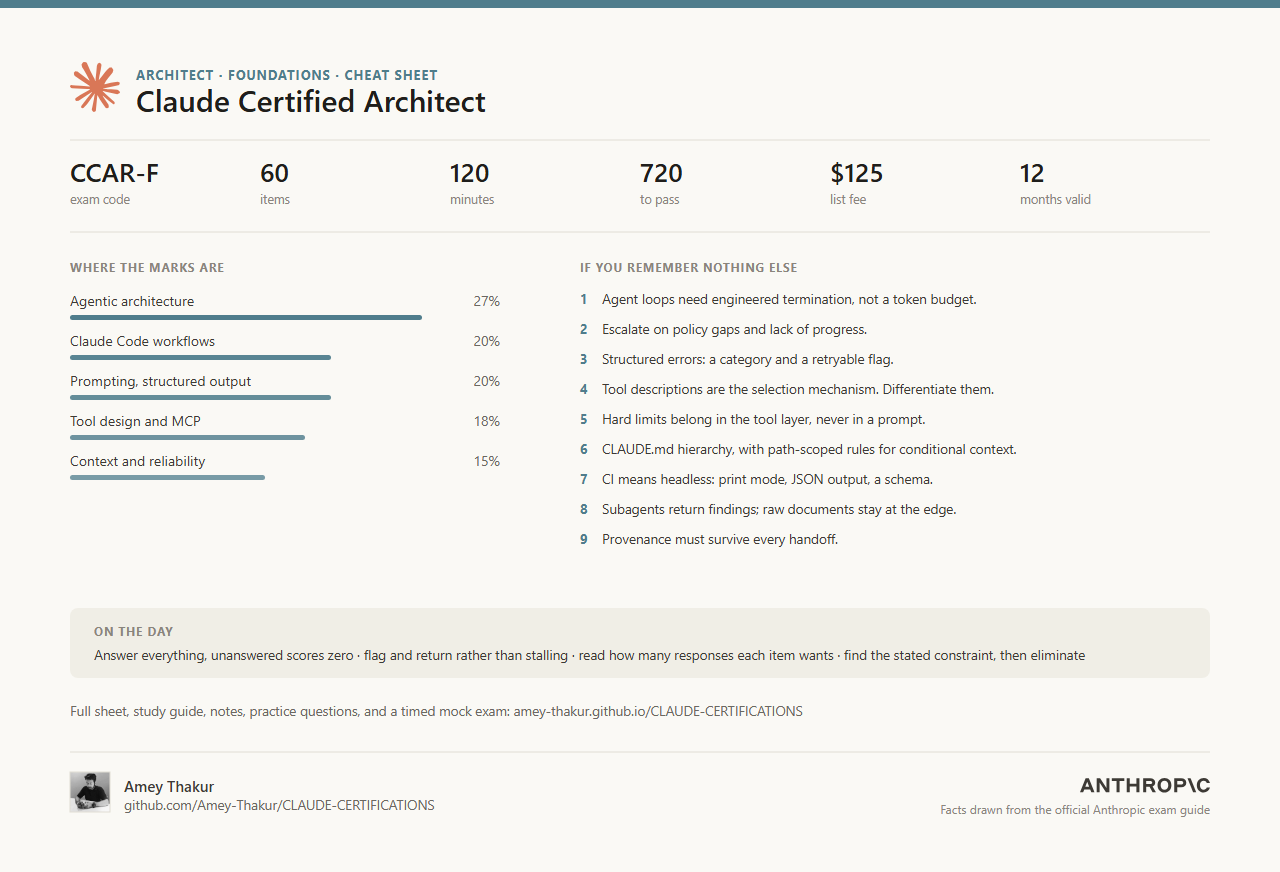
Save or share the card above; the full sheet follows.
The exam
| Code | CCAR-F |
| Items | 60, framed by 4 scenarios drawn from a published bank of 6 |
| Time | 120 minutes, about 2 minutes per item |
| Pass | 720 of 1,000, scaled |
| Fee | 125 USD before partner discount, raised from 99 on June 30, 2026 |
| Valid | 12 months, free renewal assessment |
Where the marks are
Agentic Architecture & Orchestration   27%  ██████████████████████████
Claude Code Configuration & Workflows  20%  ███████████████████
Prompt Engineering & Structured Output 20%  ███████████████████
Tool Design & MCP Integration          18%  █████████████████
Context Management & Reliability       15%  ██████████████
The six scenarios, four of which you will see
| Scenario | Rehearse |
|---|---|
| Support resolution agent (MCP tools, 80% first-contact target) | Loop termination, escalation triggers, tool scoping, structured errors |
| Claude Code for a dev team | CLAUDE.md hierarchy, path-scoped rules, plan mode, commands and skills |
| Multi-agent research with cited reports | Coordinator and subagent handoffs, provenance, error propagation |
| Developer productivity tooling | Built-in tool selection, MCP integration, large-codebase context |
| Claude Code in CI/CD | Headless invocation, JSON output, review criteria, false positives |
| Structured data extraction | JSON schema design, validation retry, batch processing, confidence |
If you remember nothing else
- Agent loops need engineered termination. Iteration caps, repeated-call detection, and an escalation path. Token budget is not a stopping condition.
- Escalate on policy gaps and lack of progress. Not on turn count, order age, or customer tone.
- Structured errors with a category and a retryable flag. An agent can only recover from a failure it can interpret. Use the isError flag.
- Tool descriptions are the selection mechanism. Differentiate similar tools precisely, or consolidate them.
- Enforce hard limits in the tool layer. Policy caps belong in code or hooks, never in a request to the model.
- CLAUDE.md hierarchy: user, project, directory. Conditional conventions go in
.claude/rules/with path scoping so context is spent only where relevant. - Plan mode is a review gate. Use it when a human should approve the approach, not universally.
- CI means headless.
-por--print,--output-format json,--json-schema. Never scrape a transcript. - False positives are cured by explicit criteria. State what to flag, what to ignore, the severity bar, and give examples.
- Subagents return distilled findings, not raw documents. Bulk stays at the edge; that is the point of delegation.
- Provenance must survive handoffs. Carry claim and source together or citations drift from claims.
- Errors propagate with context so the coordinator can retry, exclude with a noted gap, or abort.
- Nullable for legitimate absence. Required-everything forces fabrication; optional-everything hides real misses.
- Validate, then retry with the validation error. Feed the model what was wrong.
- Measure on a labeled sample of everything. Accuracy computed only on records that passed validation is a biased number.
Appendix items worth knowing cold
stop_reason values, PostToolUse hooks, allowedTools, the Task tool for subagents, .mcp.json with environment expansion, isError, .claude/skills/SKILL.md frontmatter (context: fork, allowed-tools, argument-hint), /memory, /compact, --resume, fork_session, the Explore subagent, tool_choice, Message Batches (50% saving, 24-hour window, custom_id, no multi-turn tool calling), lost-in-the-middle effects, scratchpad files, confidence calibration.
Working the clock
60 items across 4 scenarios in 120 minutes. The scenarios each carry a block of questions, so pace by block rather than by item.
- Read each scenario once, carefully, before its questions. Two minutes spent understanding the system saves more than it costs, because every question in the block leans on it.
- First pass, about 70 minutes. Work each block in order. Flag anything needing more than 90 seconds.
- Second pass, about 30 minutes. Return to the flags with the whole scenario now familiar.
- Last 20 minutes. Re-read multiple-response items and confirm selection counts.
Reading a question the way it is written
Because you know the six scenarios in advance, you can walk in already knowing what each one is about to test. Use that: when the block opens, recall the primary domains listed for that scenario and expect the questions to sit there.
Within a question, find the constraint (reliability, cost, context limits, safety, maintainability) and eliminate everything that does not address it. The winning option almost always removes a structural weakness; the distractors add capacity, add supervision, or ask the model to be careful.
The morning of
- Run the system test again on the exam machine, even if it passed last week
- Close everything on the shutdown list before check-in, including the Claude desktop app
- ID ready, room clear, desk clear, second monitor unplugged
- Check-in takes longer than you expect; start early
- 135 minutes of seat time; eat first
If you blank
Move on within the block and come back. Scenario questions are mutually reinforcing: a later question in the same block often clarifies what an earlier one was asking.
Exam day logistics
- ID name must match your registration exactly
- Closed book. No notes, no documentation, no translation tools
- Answer everything; unanswered scores zero
- Read the scenario once carefully, then answer its questions against that context
- If you attempted this exam before June 30, 2026 and did not pass, that attempt was cleared: no waiting period
Facts last verified against the official sources on 2026-09-16. Study guide · Notes · Practice questions · Mock exam · Repository index