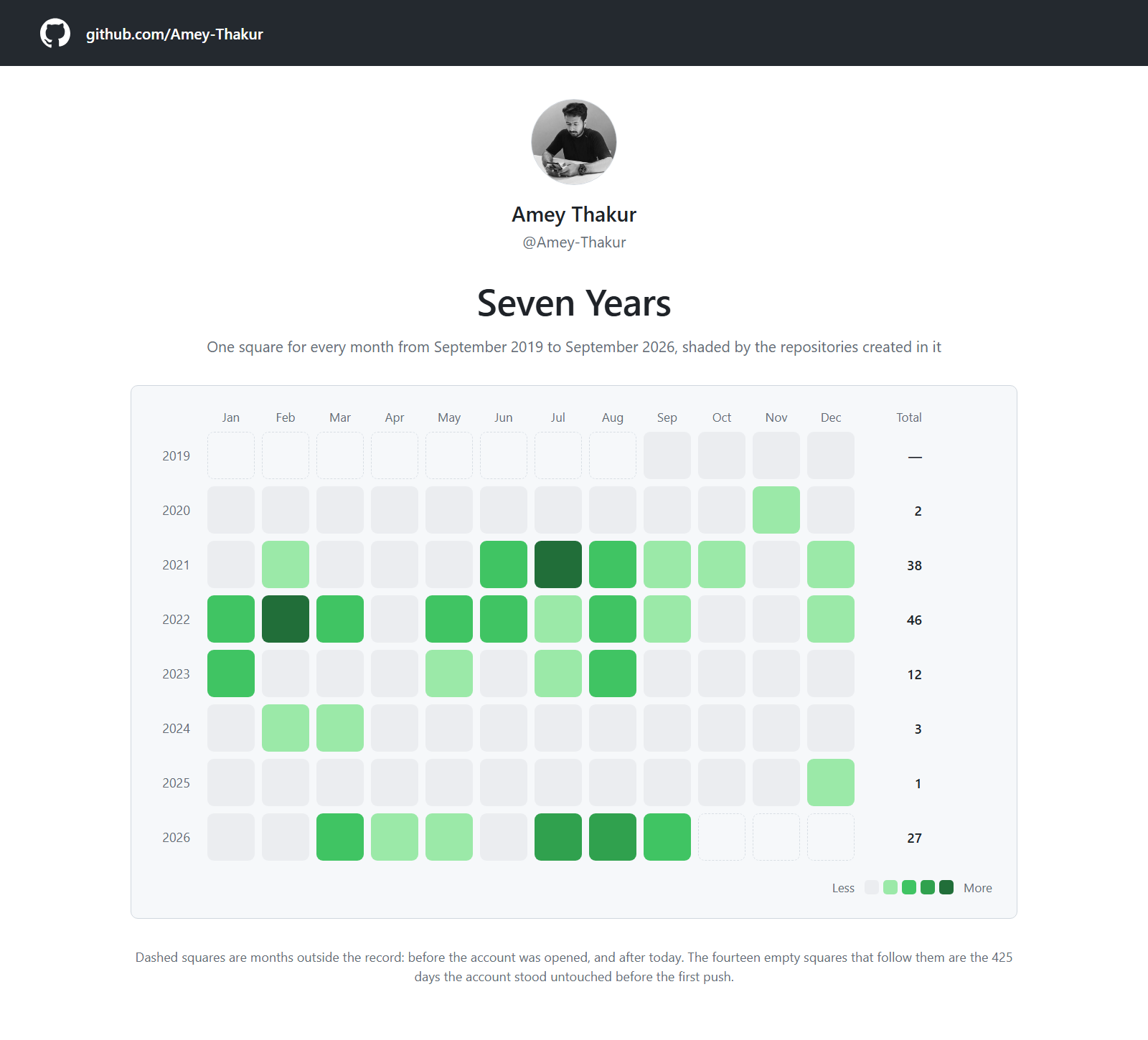
Seven years, one square per month, with each year’s total on the right. The first push is November 2020. Every empty square before it is part of the 425 day wait.
My name is Amey Thakur. Seven years ago today I opened a GitHub account, github.com/Amey-Thakur, in Mumbai, in the second year of a bachelor’s degree. This is an honest accounting of what has happened to it since, including the parts that do not flatter me.
5 September 2019, 09:48:39 UTC
That is when I opened it. I know the second because GitHub keeps it, and it is the only part of the story I did not have to reconstruct.
That was 15:18:39 IST. I was in Mumbai, in the second year of a B.E. in Computer Engineering. The account has changed countries since, to a master’s at Windsor and everything after it, and I have never opened another one.
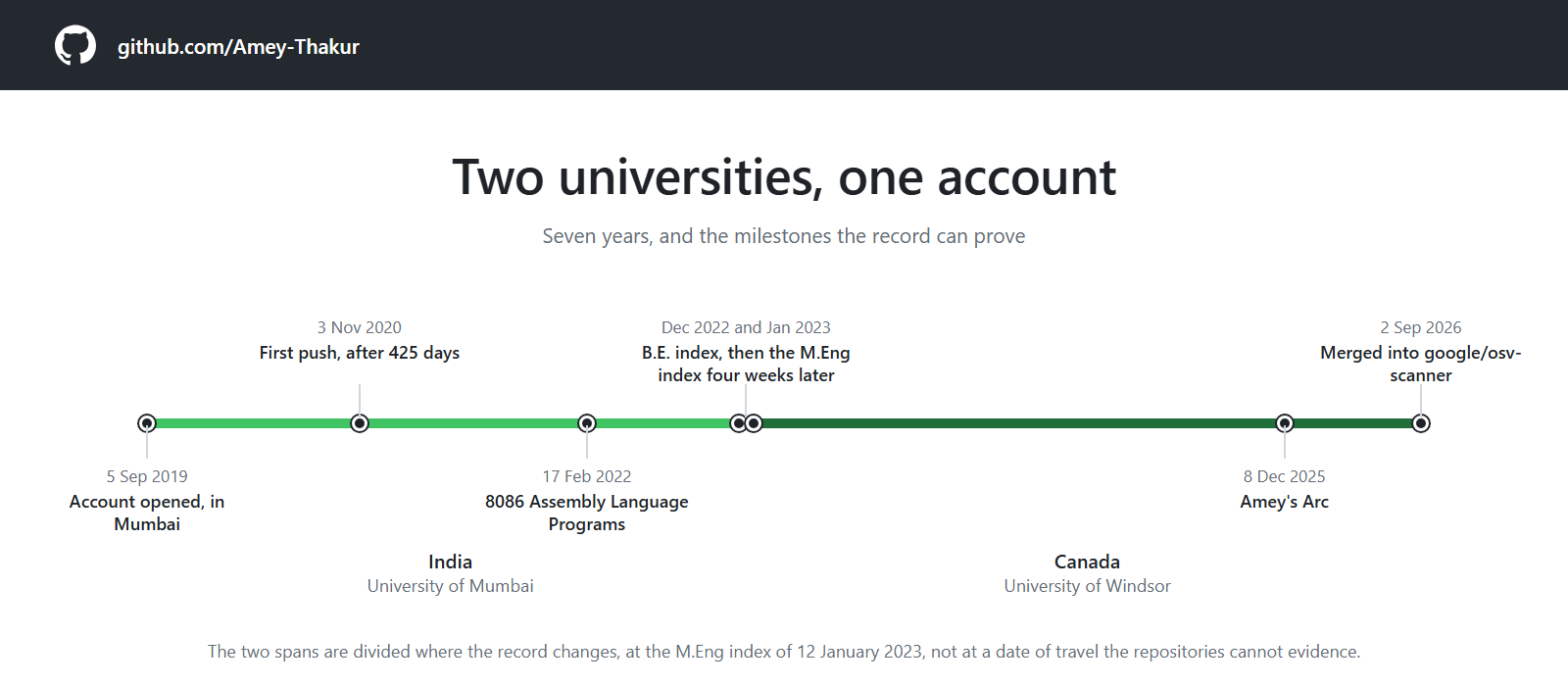
Seven years on one axis. The two spans are divided where the record changes, not at a date of travel the repositories cannot evidence.
Nothing was pushed to it for 425 days.
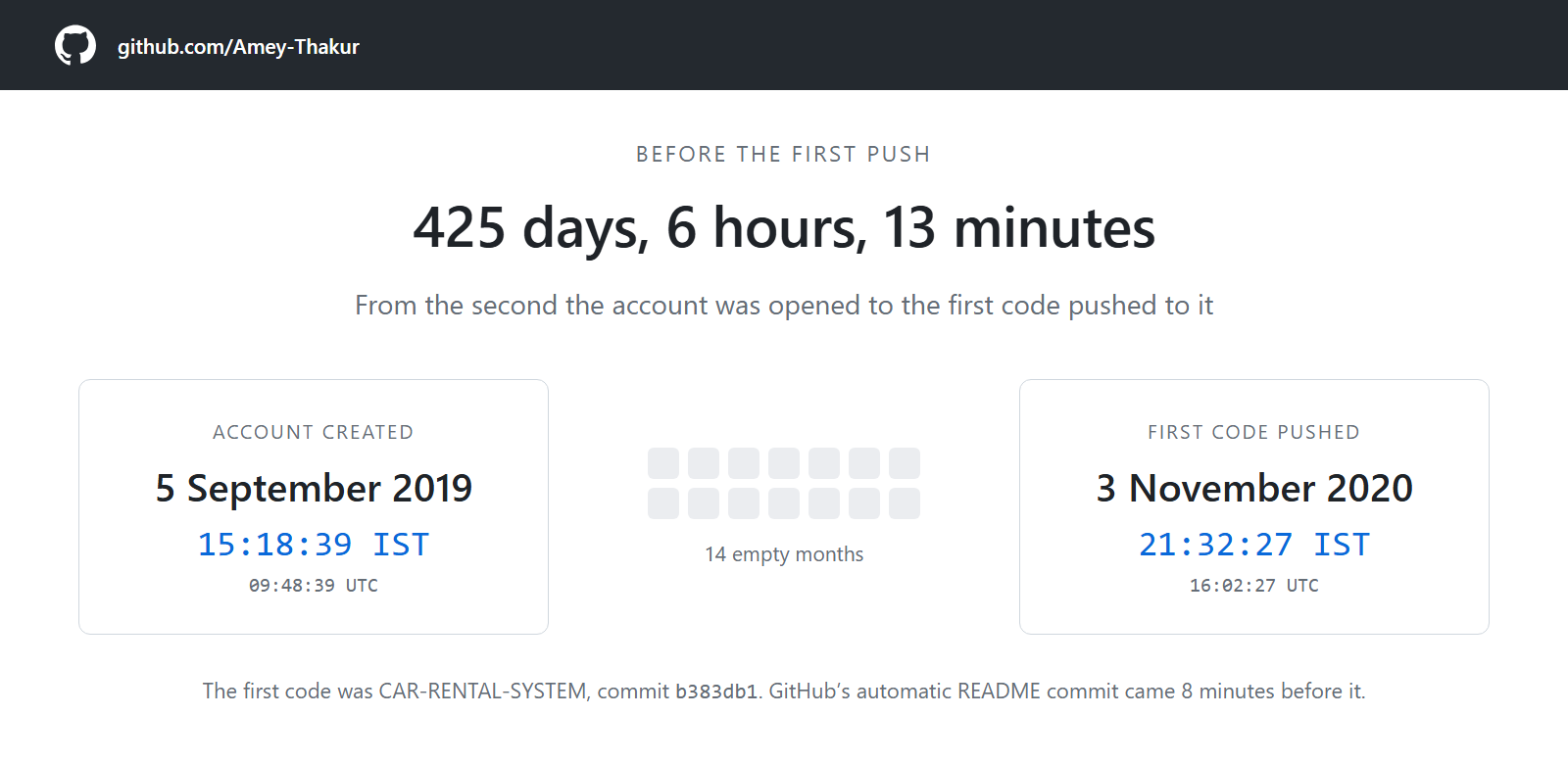
The exact distance between opening the account and putting anything into it, counted from the second of each. Fourteen months of the record are empty.
Not because anything was being built in private. I was waiting until there was something worth putting up. At the time that felt like having standards. In hindsight it was a category error: I was treating publication as a reward for work already finished, when publication is closer to the place work goes in order to become finished. Nothing in those fourteen months improved by being kept back.
3 November 2020
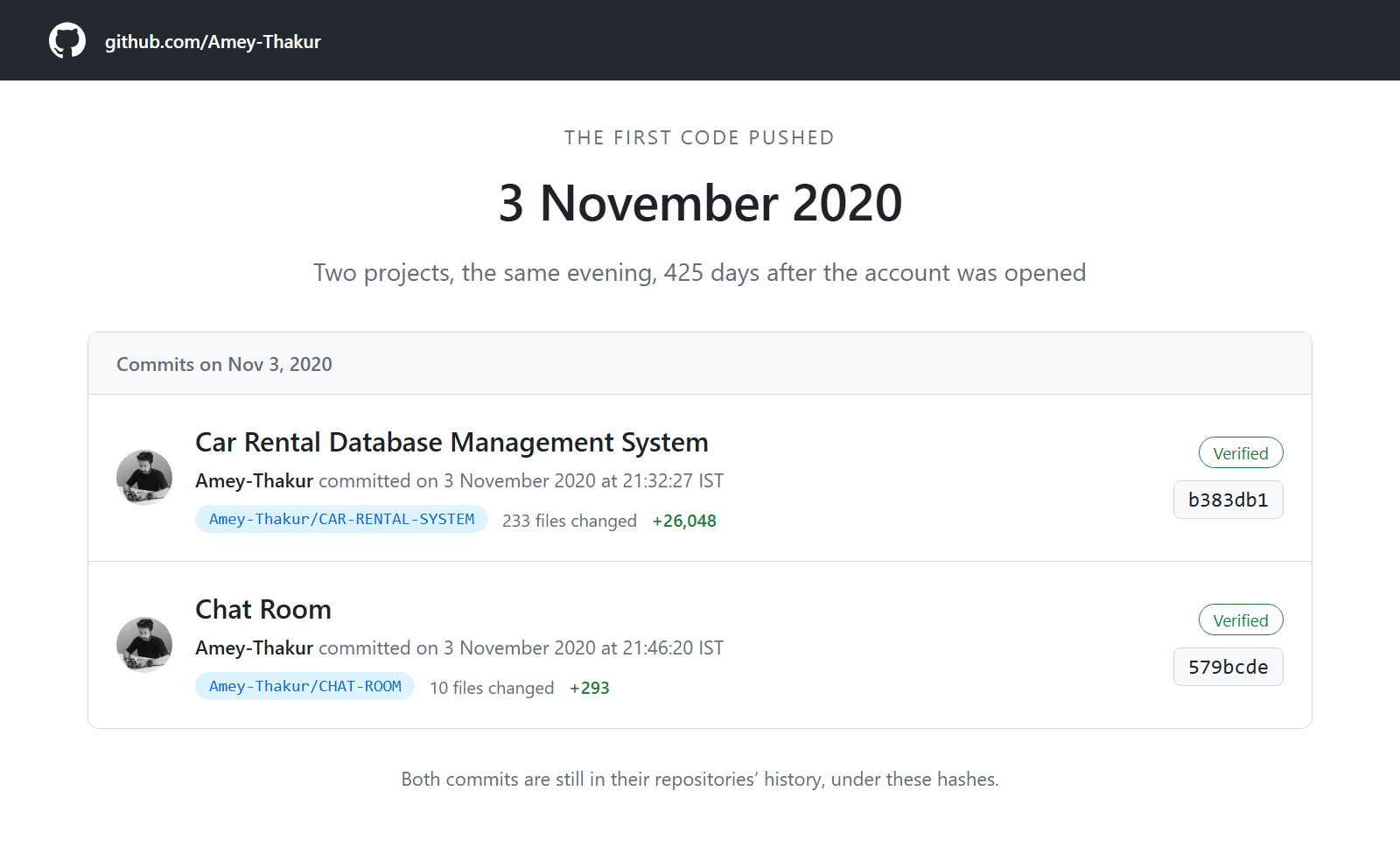
The first code on the account, both projects pushed within a quarter of an hour of each other. The hashes are still in their repositories today.
The wait ended with a car rental system and a chat room, pushed on the same day. Both are full-stack web systems: a database-backed booking platform with separate user and administrator interfaces, and a real-time chat application using AJAX for asynchronous updates and dynamic DOM changes.
Both were later published as research papers, the car rental system in the International Journal for Research in Applied Science and Engineering Technology, Volume 9, Issue 7.
That is the part worth sitting with. The work held back for fourteen months because it did not yet feel worth publishing was, once published, worth publishing twice. The judgment I was waiting to develop was not going to arrive in private. It arrived from putting the thing where it could be judged.
The shape of seven years
Repositories created per calendar year, counted today.
| Year | Created |
|---|---|
| 2020 | 2 |
| 2021 | 38 |
| 2022 | 46 |
| 2023 | 12 |
| 2024 | 3 |
| 2025 | 1 |
| 2026 | 27 |
The shape is not flattering at first glance, and I nearly left it out. It is the most useful thing on this page.
The two peaks are the bachelor’s degree going up as it happened. The trough covers the master’s and the move to Canada. One repository in the whole of 2025.
For a long time I read a year like that as a gap in the record, which is another way of saying a gap in the person. It is not. The habits that produced 2026 were formed in 2025, when nothing was shipping: reading more carefully, writing things down for my own use, learning what a finished artefact actually requires. A public feed measures publication, and publication is a lagging indicator of almost everything that matters.
If you are in a year like that now, the useful reframing is that the graph is recording your output, not your rate of improvement, and the two are allowed to be a year apart.
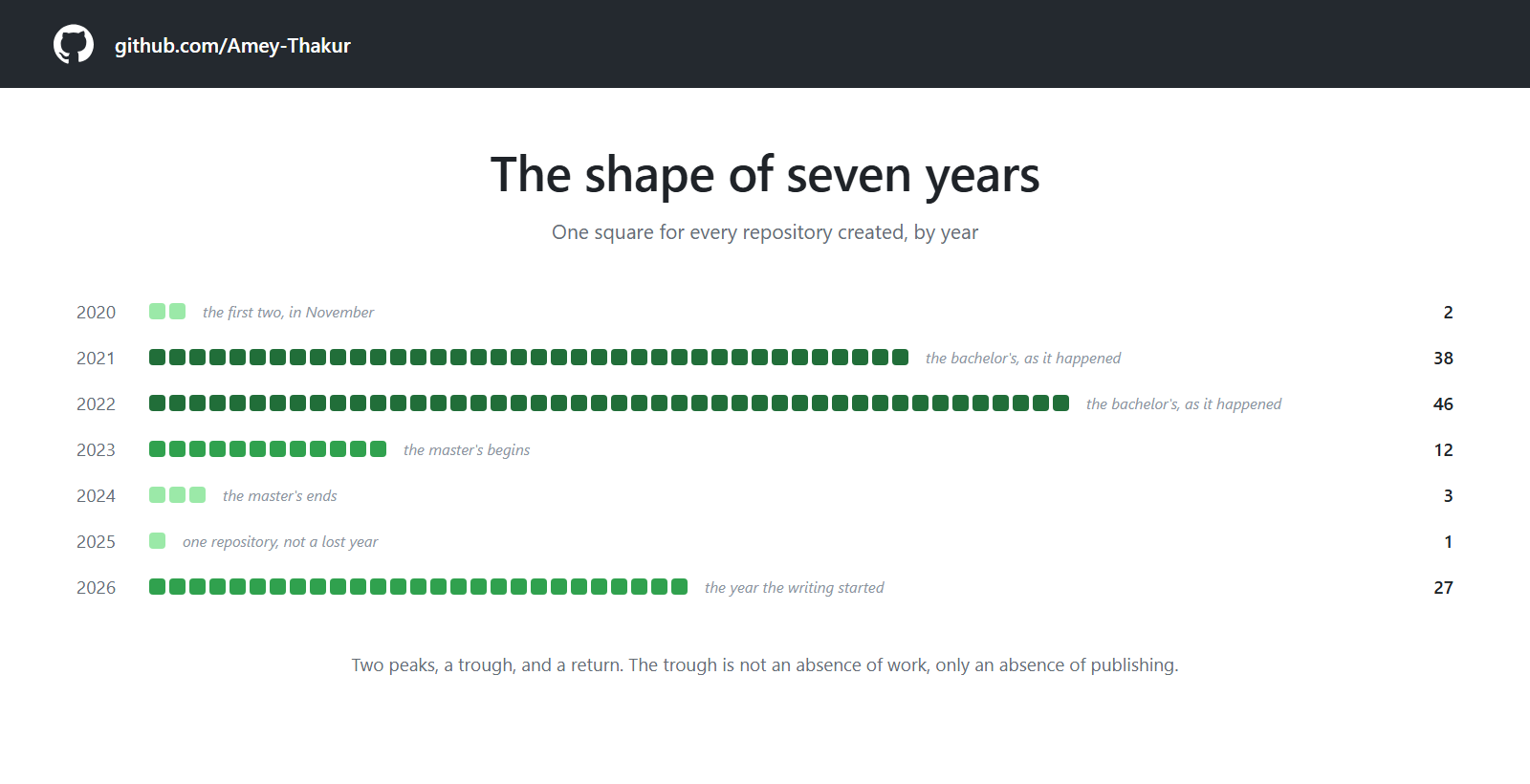
The same figures as the table above, as proportions. Two peaks, a trough, and a return.
Year by year
The totals hide more than they show. Here is each year on its own, month by month, with what the shape of it was actually caused by.
2020
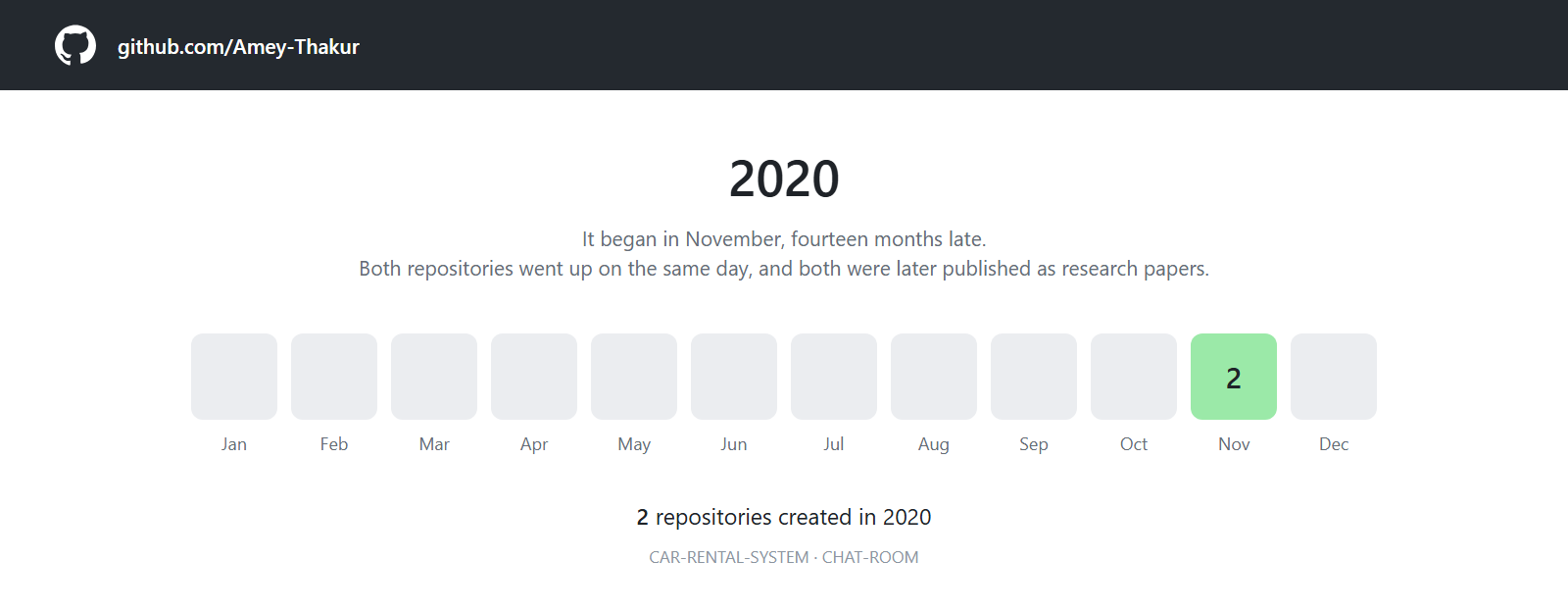
The account was fourteen months old before anything went into it. What broke the silence was a database-backed booking system with separate user and administrator interfaces, and a real-time chat application using AJAX, pushed on the same day.
Both were later published as research papers. That is the fact I would send back to myself in 2019, because it inverts the reasoning that produced the delay. I was holding work back until it was good enough to publish. It was already good enough to publish. Waiting did not improve it; it only postponed finding out.
2021
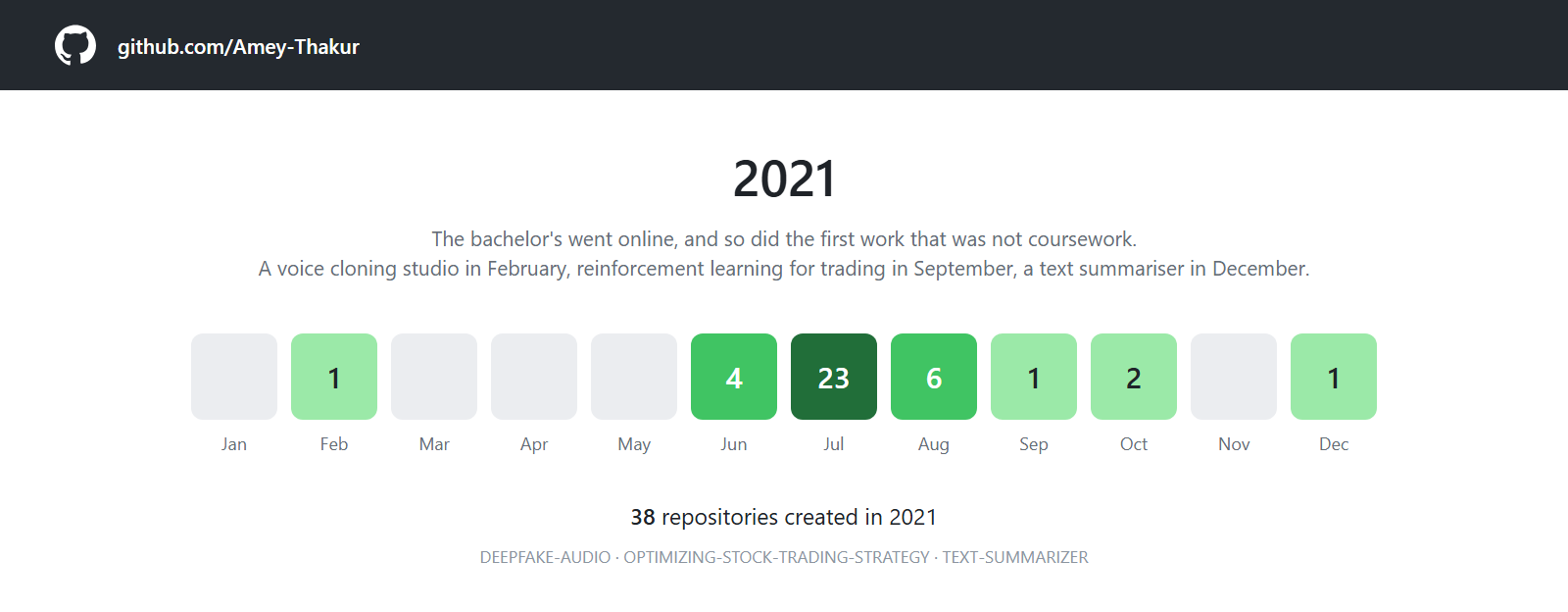
Thirty-eight repositories, and the bachelor’s went online in bulk: twenty-three in July alone, long after the coursework itself was finished.
Read as a graph, that July is an extraordinary month. It was a backlog and some free evenings. A profile records when you published, not when you learned, and those two timelines can be years apart.
The more interesting entries are the ones nobody assigned. A neural voice cloning studio in February, a reinforcement learning system for trading strategies in September, a text summariser in December. This is the year the account stopped being a submission folder and started being a body of work, and the change was not announced. It shows up only as three squares that do not belong to any syllabus.
2022
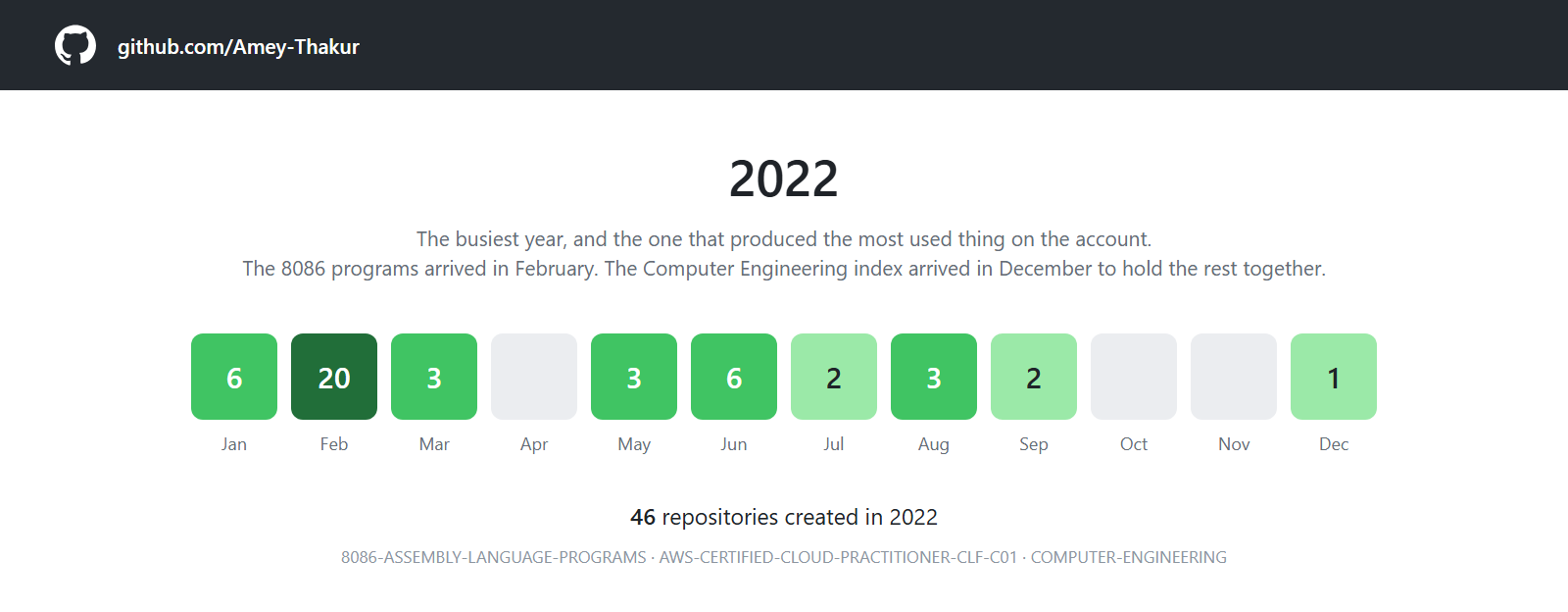
The busiest year, and still the one that defines the profile.
February produced the 8086 assembly programs, which remain the most used thing here by a wide margin, and twenty repositories went up in that month alone. December produced the Computer Engineering index: the least glamorous repository on the account and, on reflection, close to the most valuable, because it is the reason the dozens of repositories beneath it can be found at all. An index is not work. It is the thing that makes work findable, and I have never regretted the day spent building one.
2023
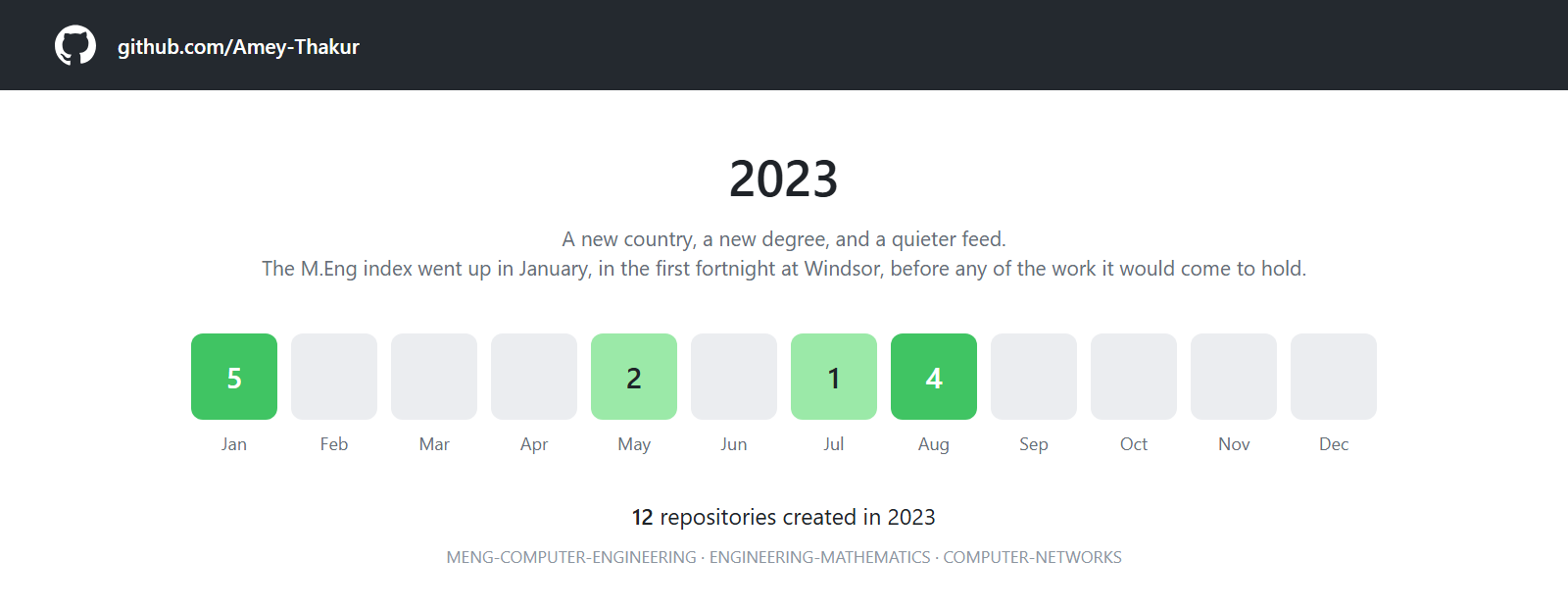
Twelve repositories, a new country and a new degree.
The M.Eng index went up on 12 January, inside the first fortnight at Windsor, before there was a single piece of coursework to put in it. Building the container before the contents looks like procrastination and is the opposite: everything that followed had somewhere to go on the day it was finished, which is exactly what the account itself lacked in 2019.
2024
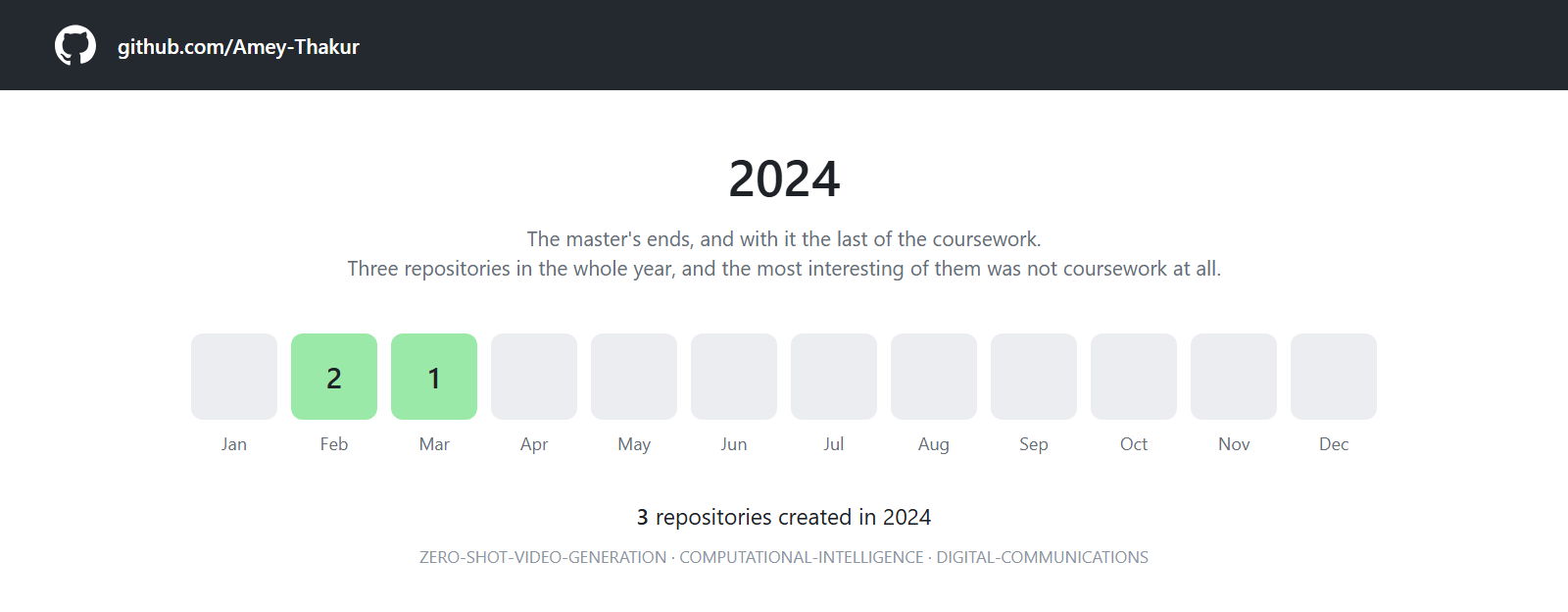
Three repositories in a whole year, and the end of the coursework.
March brought zero-shot video generation, the only one of the three that nobody assigned, and the most used of the three by a comfortable margin.
I want to resist drawing the obvious moral from that, because the account contradicts it: the single most used thing here is a microprocessors lab, which was very much assigned. What the three of 2024 actually show is narrower and truer. In a thin year, the work that survives being looked at later is the work that was chosen rather than required.
2025
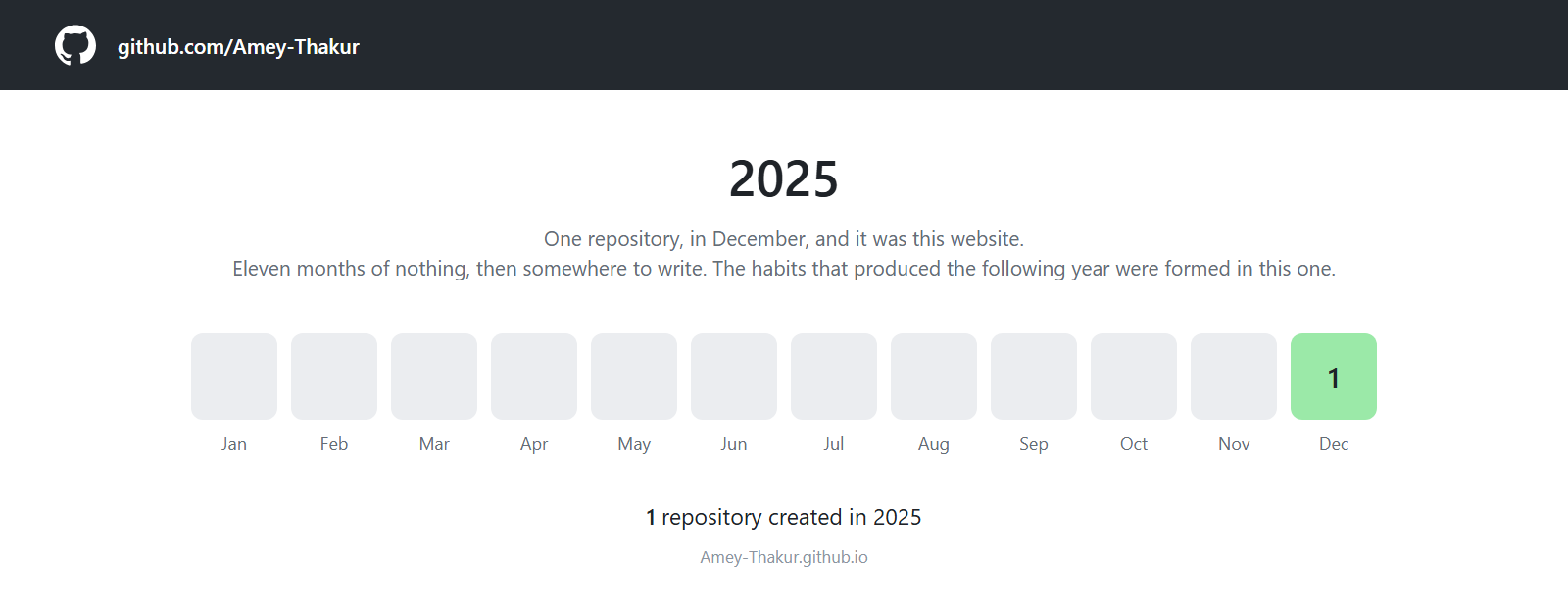
One repository, in December, and it was this website.
Eleven months of nothing precede it. This is the year I would have hidden a few years ago, and it is the one I now think is worth the most to anyone reading. Nothing in that stretch was idle. It was reading more slowly, keeping notes that were not for publication, and working out what a finished artefact actually requires. None of that creates repositories, so none of it appears above.
A contribution graph measures publication. Publication is a lagging indicator of almost everything that causes it. If your own graph has a year like this in it, the graph is not the measurement you think it is.
2026
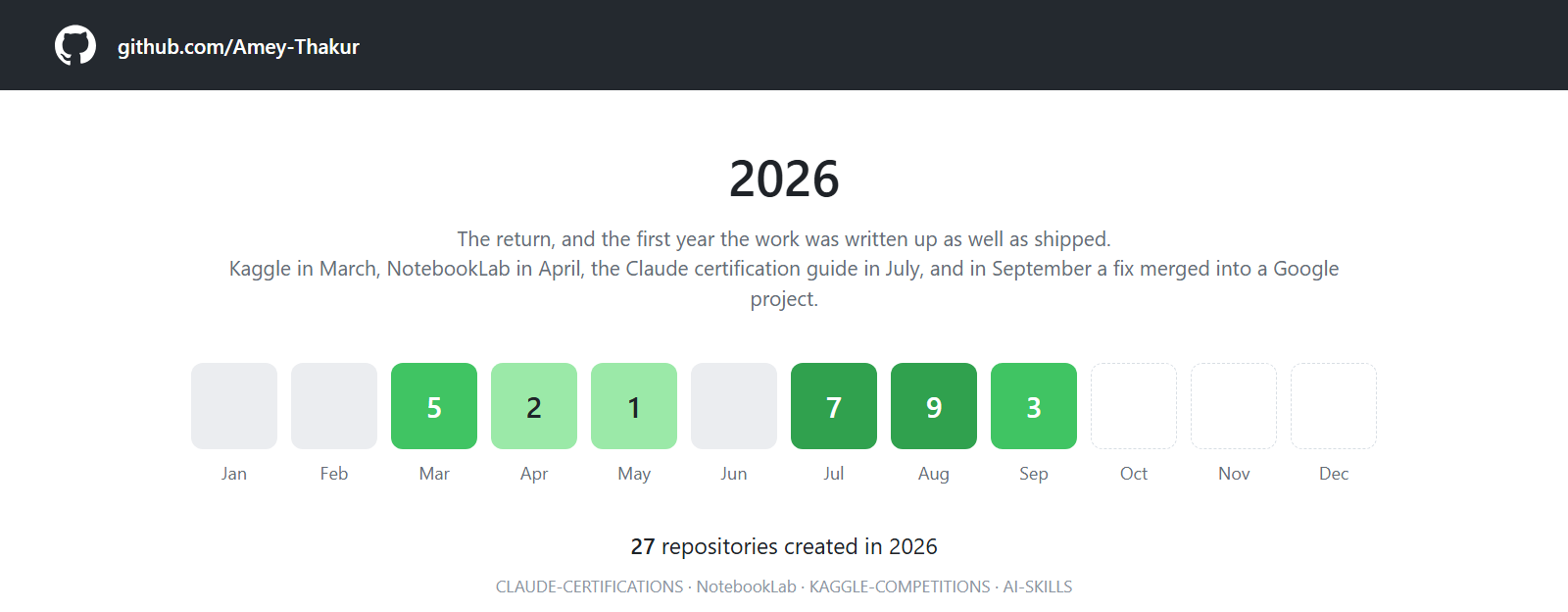
Twenty-seven repositories, and the first year the work has been written down as carefully as it was built.
Kaggle in March, NotebookLab in April, the Claude certification guide in July, and in September a fix merged into one of Google’s own projects. The difference between this year and 2022 is not volume, and 2022 is still ahead on that. It is that the work now arrives with its reasoning attached, and that the thing built and the account of why it was built go up together.
That is the whole of what the quiet year bought.
What travelled furthest, and why
The natural assumption is that the work which reaches people will be the work that was hardest to do. Seven years of evidence says otherwise, and the reason turned out to be more useful than the observation.
The most used repository on my GitHub is 8086 Assembly Language Programs: 525 documented Intel 8086 programs with a browser simulator that assembles and runs every one of them, the full instruction set, nine flags, macros, DOS and BIOS services, step-by-step debugging, verified by 2,010 tests. Behind it, AWS certification material, a neural voice cloning studio built on SV2TTS, and a reinforcement learning system for stock trading strategies.
For years I read that ranking as a verdict on what the internet rewards. It is not. Every item on it shares one property that none of my papers has.
You can run it without asking me anything.
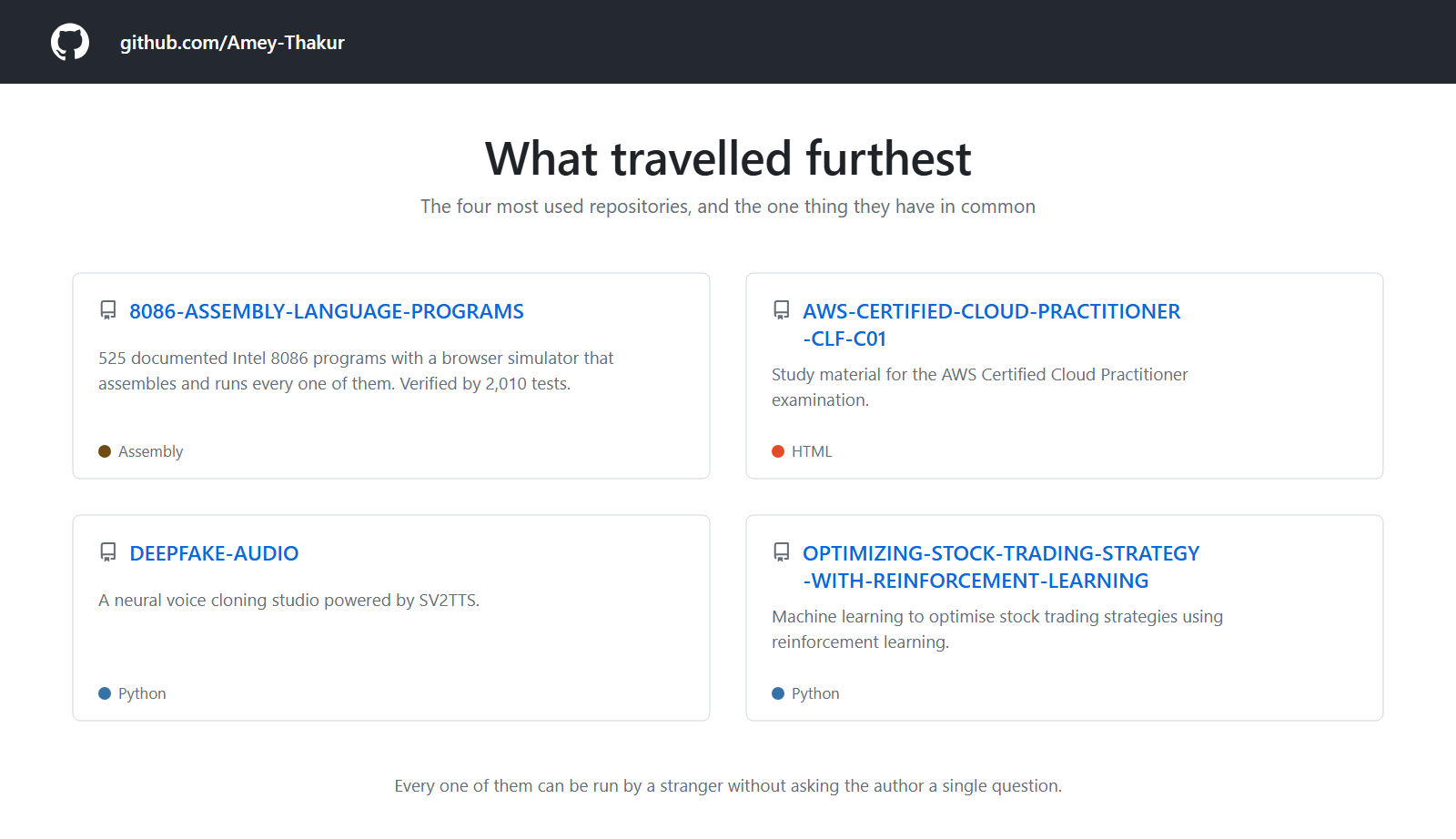
The four most used repositories. Not one of them is a paper, and every one of them can be run by someone who never contacts me.
A paper asks a reader to accept a result. A simulator lets them produce the result themselves, at two in the morning, with a deadline tomorrow and no appetite for correspondence. The distance between those two experiences accounts for the entire difference in reach. This is not rigour losing to popularity. It is a closed artefact losing to an open one.
That reframing changed how I finish things. The question at the end of a project is no longer is this correct, which it has to be regardless. It is:
What would a stranger have to ask me before this became useful to them?
Then I remove those questions one at a time. A simulator removes all of them at once. So does a worked example, a downloadable file, a page that runs in a browser with no key, a command someone can paste. Each removal is small. Together they are the difference between work that exists and work that travels.
Every idea I open-source is a spark handed to someone I may never meet. That is the whole point.
– Amey Thakur
None of this is an argument for less research. This year alone there is a zero-shot accident detection pipeline released as a preprint, a geometric criterion that dates a hand gesture to the frame it happened on, and, on 2 September, a fix merged into Google’s OSV-Scanner for a stack overflow that a few megabytes of open brackets could trigger in any scan. The gesture work shipped as a paper and as an application that runs in a browser with no server and no key. That is the lesson applied rather than merely noticed, and it is the first time I have done both deliberately.
What my GitHub is actually made of
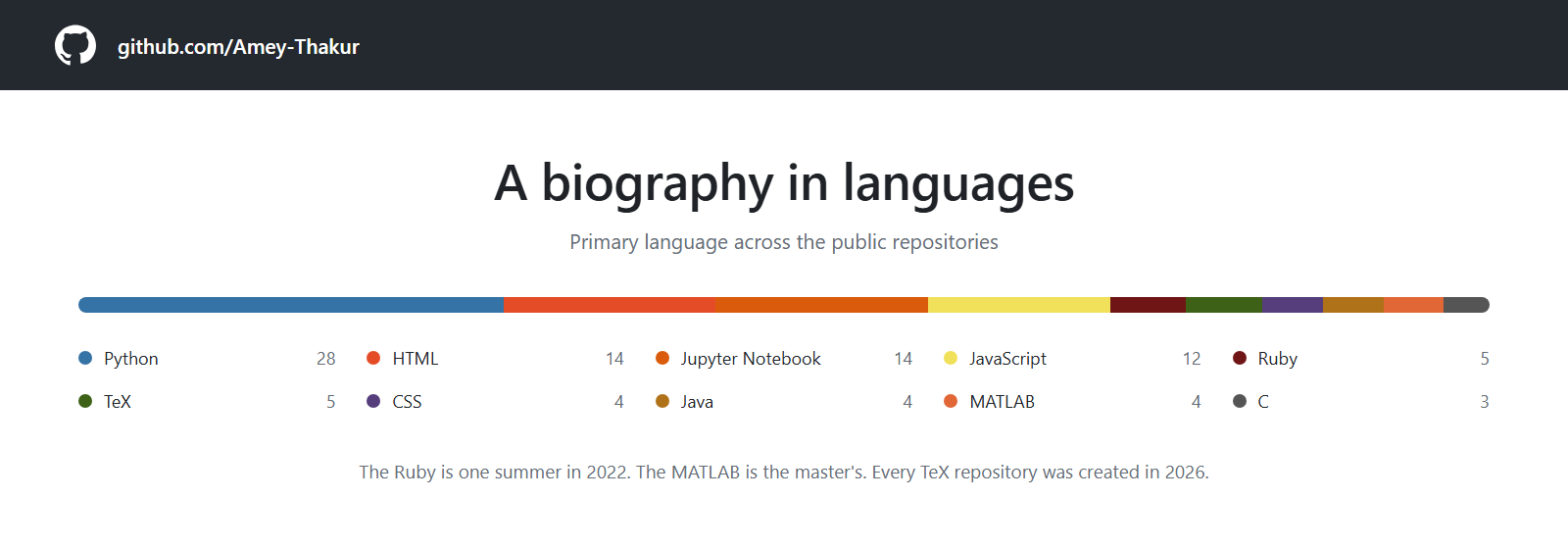
Primary language across the public repositories, in Linguist’s own colours.
That distribution is a biography. The Ruby is five repositories from 2022, a Rails application and a pair of small games written the summer I wanted to learn the language. The MATLAB is four repositories from the master’s, 2023 to 2024: computational methods, computational intelligence, digital communications and adaptive cruise control. Every TeX repository was created in 2026, because that is when the writing started. Nobody plans a distribution like this. It is a curriculum and a set of interests, fossilised.
The sweep itself covered 120 repositories, of which 58 serve a published site and 64 run CI, totalling 114 workflows. Slightly more than one repository in three publishes something a browser can open, which is the runnable-artefact principle showing up as infrastructure rather than as intention.
What the seven years hold
Most of my GitHub is a degree, twice. The coursework is not loose in the profile; it is indexed, semester by semester, in two repositories that exist so the rest can be found.
| Computer Engineering | B.E. Computer Engineering, University of Mumbai, 2018 to 2022. Every subject, lab and project, indexed by semester. |
| M.Eng. Computer Engineering | M.Eng. Computer Engineering, University of Windsor, 2023 to 2024. The same, for the master’s. |
The rest divides in two. Some of it was built because it was useful.
| GIT-GUIDE | Every Git and GitHub answer in one place. Ask in plain language, get the exact commands, the danger level and the undo. |
| GITHUB-TRICKS | The features, URL tricks, search qualifiers and Actions patterns worth knowing, each verified against its source, with the trap nobody else writes down. |
| NotebookLab | A thinking partner that runs on your own machine. Import documents, ask questions, keep the answers local. |
| PI | Everything about one number: verified digits, working algorithms in three languages, a written atlas, and a site that makes it playable. |
| CLAUDE-CERTIFICATIONS | A study guide for all four Anthropic Claude certifications, built only from published material and given away. |
| KAGGLE-COMPETITIONS | Competition solutions kept as they were worked, with the write-up explaining where each approach ran out. |
| ACHIEVEMENTS | Every certificate and credential, each with the link that verifies it. |
The rest was entered somewhere, or sent upstream, which is a different kind of work. It has a deadline set by someone else and a judgement at the end of it that is not mine to make.
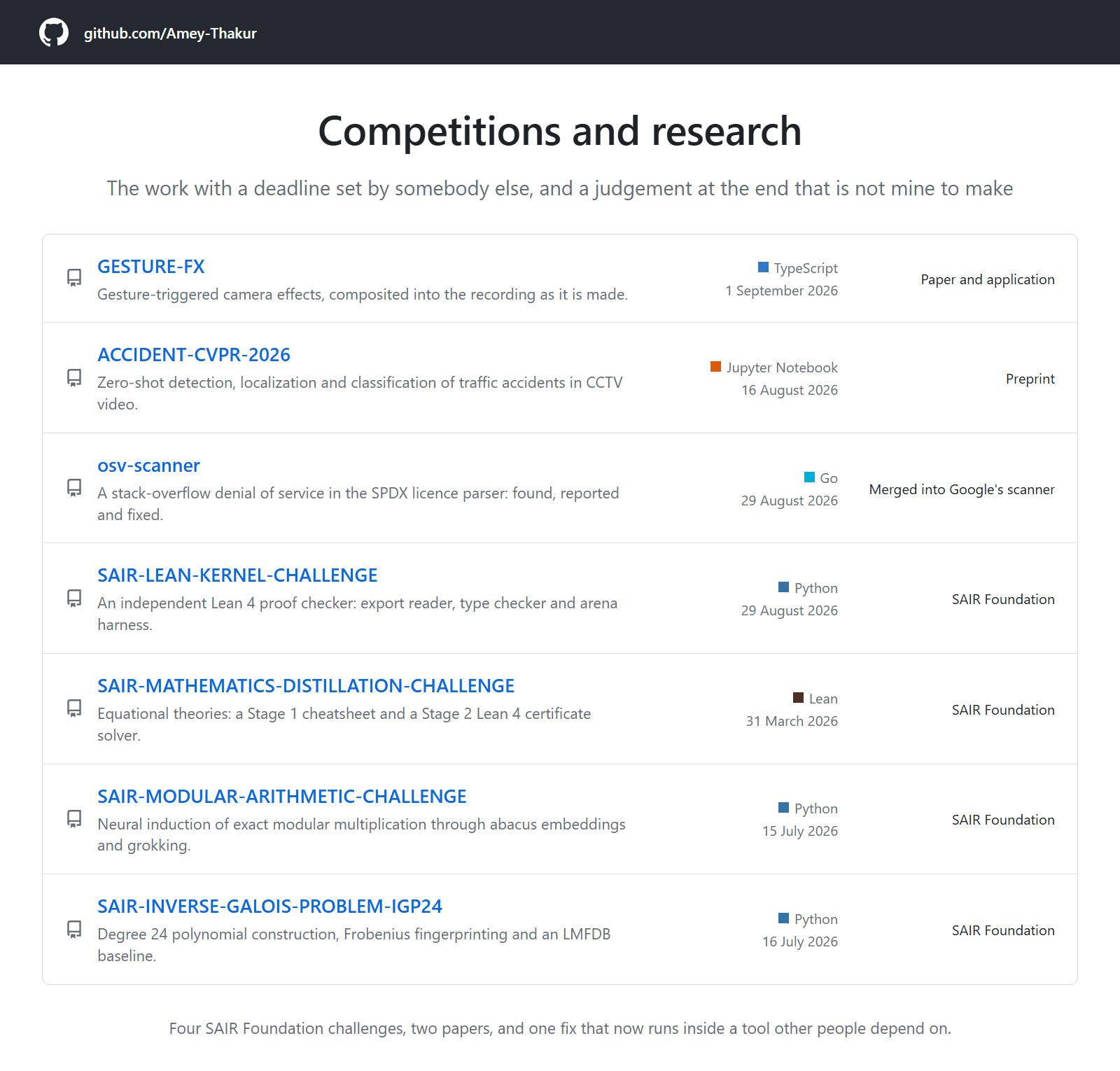
Four SAIR Foundation challenges, two papers, and one fix that now runs inside a tool other people depend on.
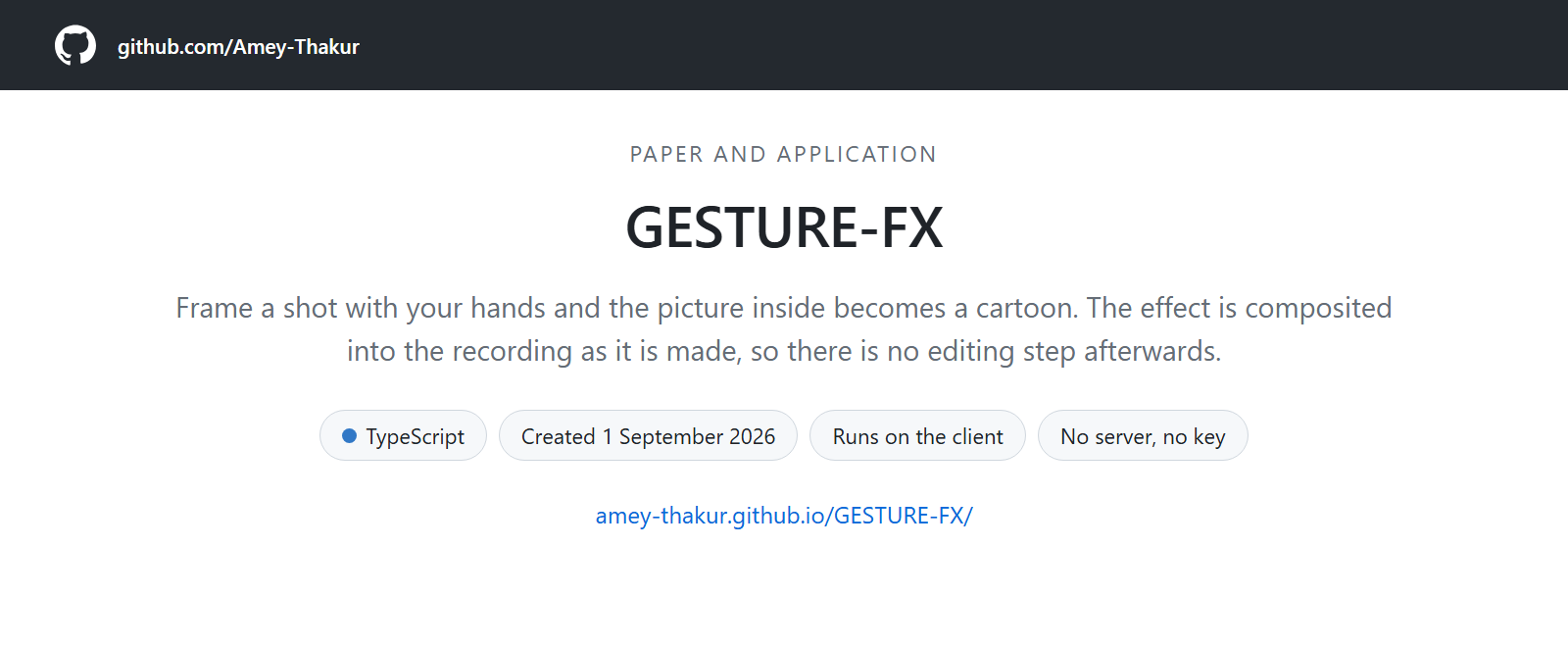
The only piece here that shipped as a paper and as something you can open in a browser on the same day.
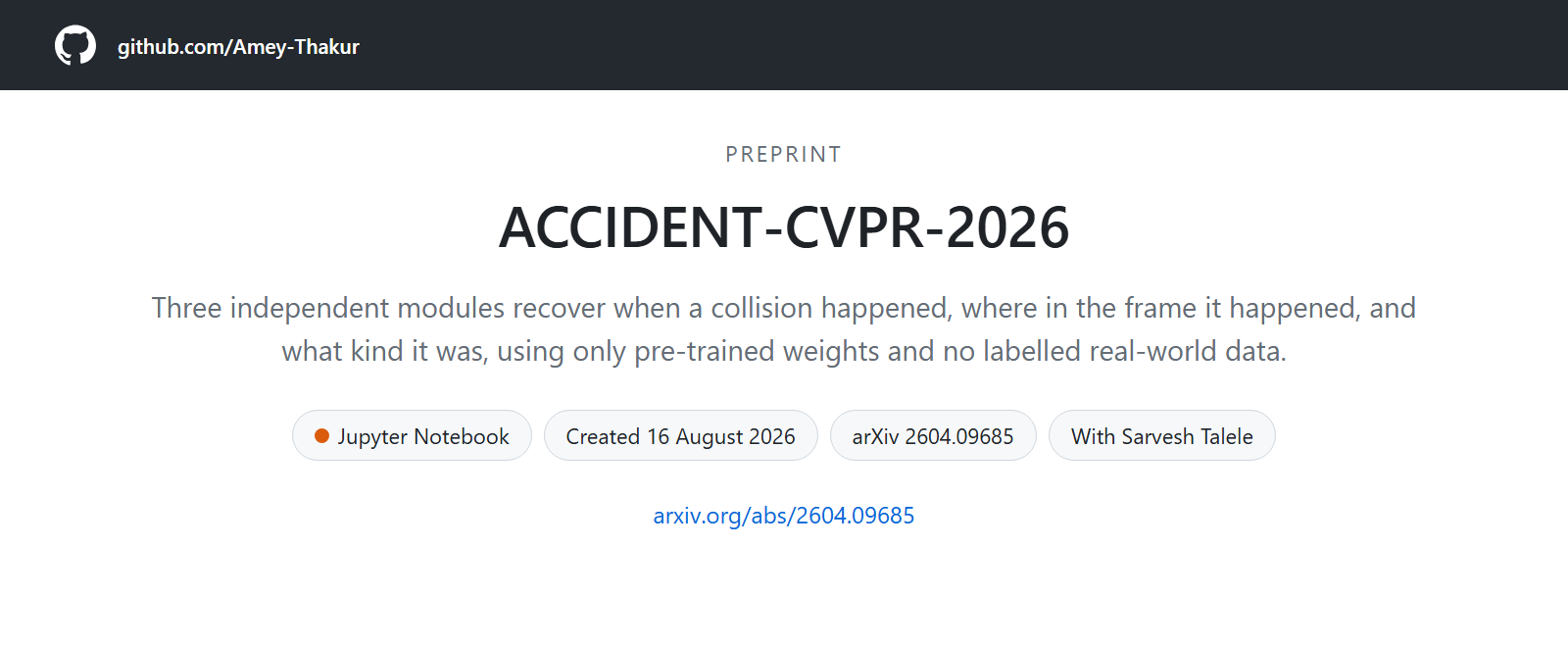
Three modules that share no parameters, so any one of them can be replaced without disturbing the others.
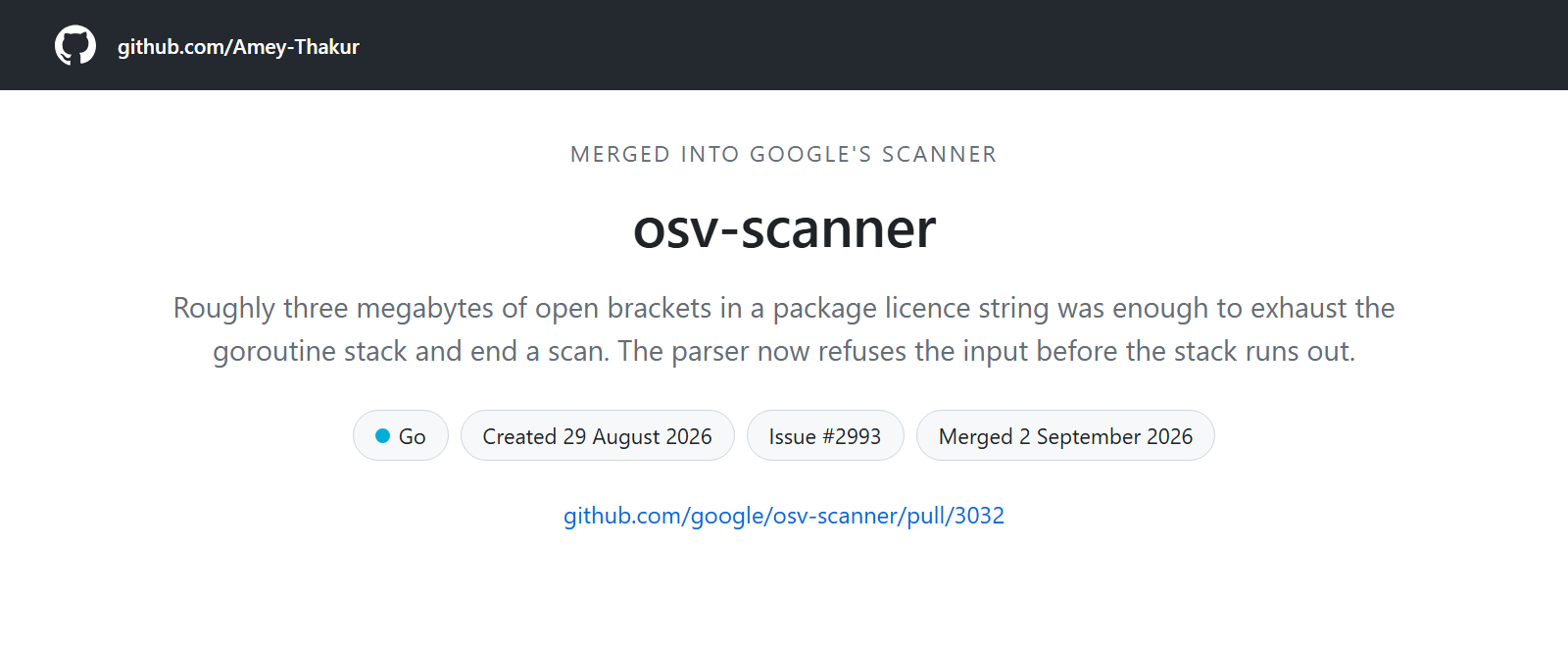
The only thing on this account that now runs inside software other people depend on.
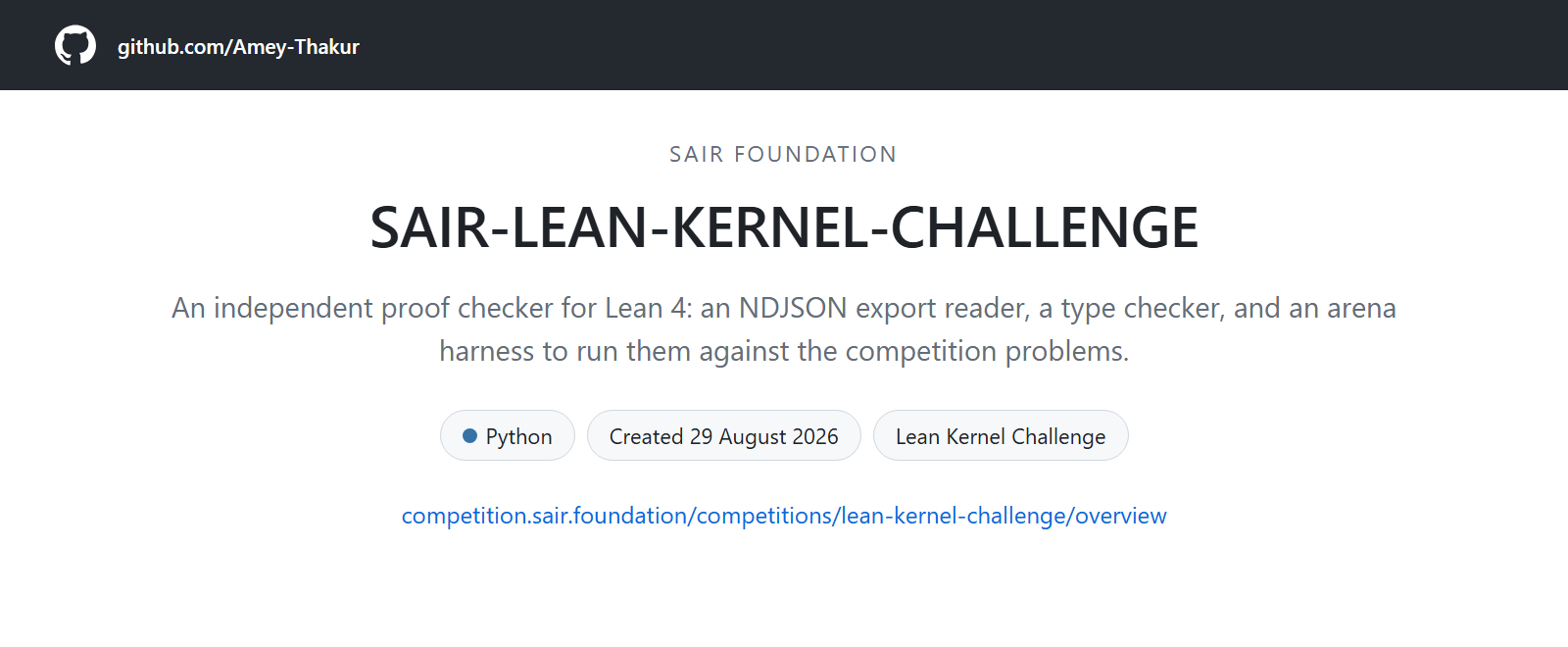
Writing a proof checker is the clearest way to find out whether you actually understand the thing being checked.
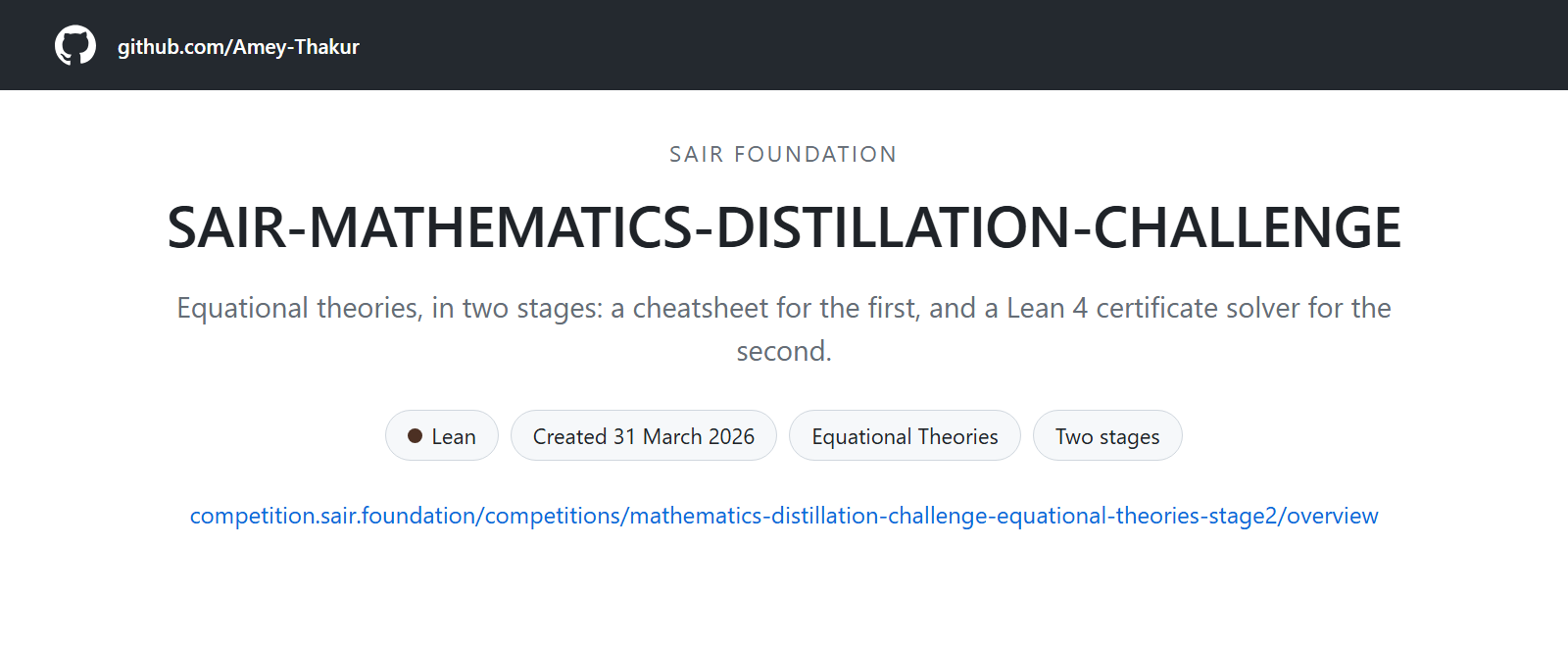
The earliest of the four, and the one that made the other three possible.
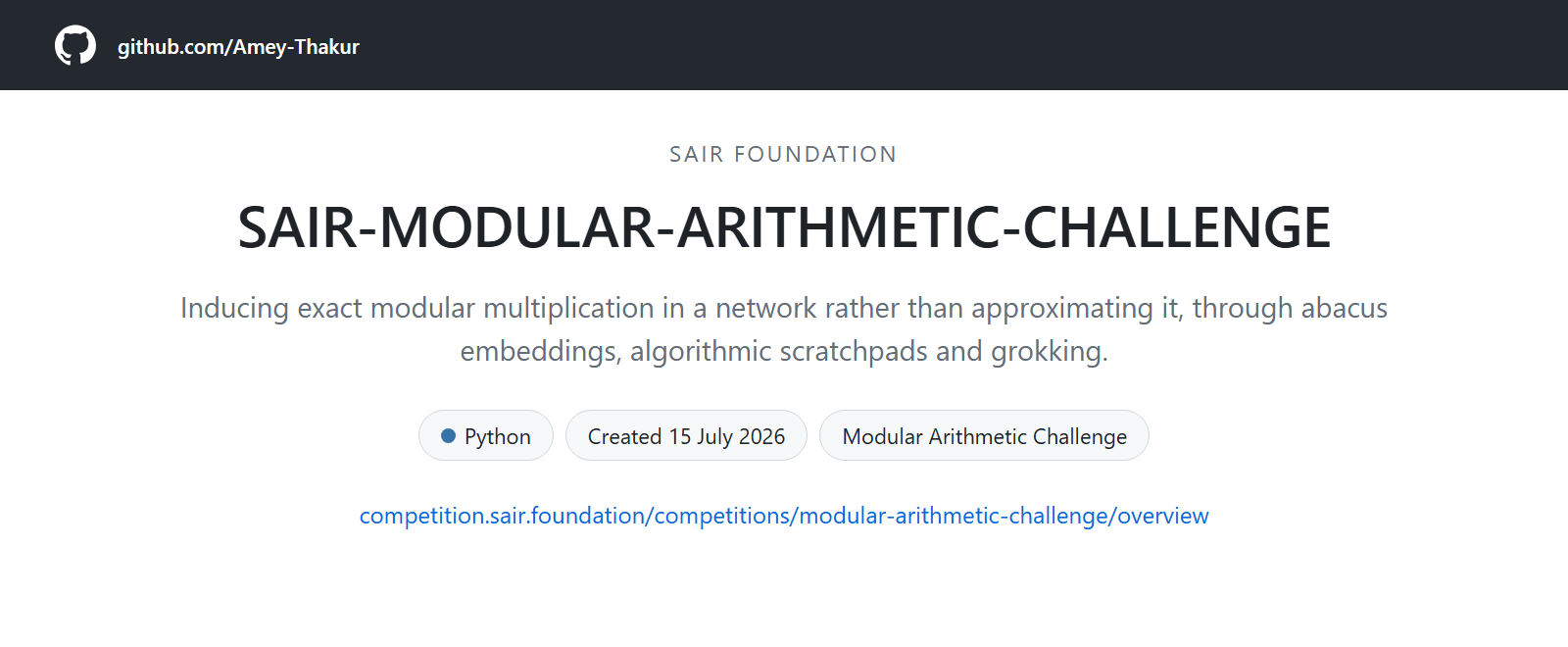
Inducing an exact operation rather than approximating it, which is a different problem from the one networks are usually given.
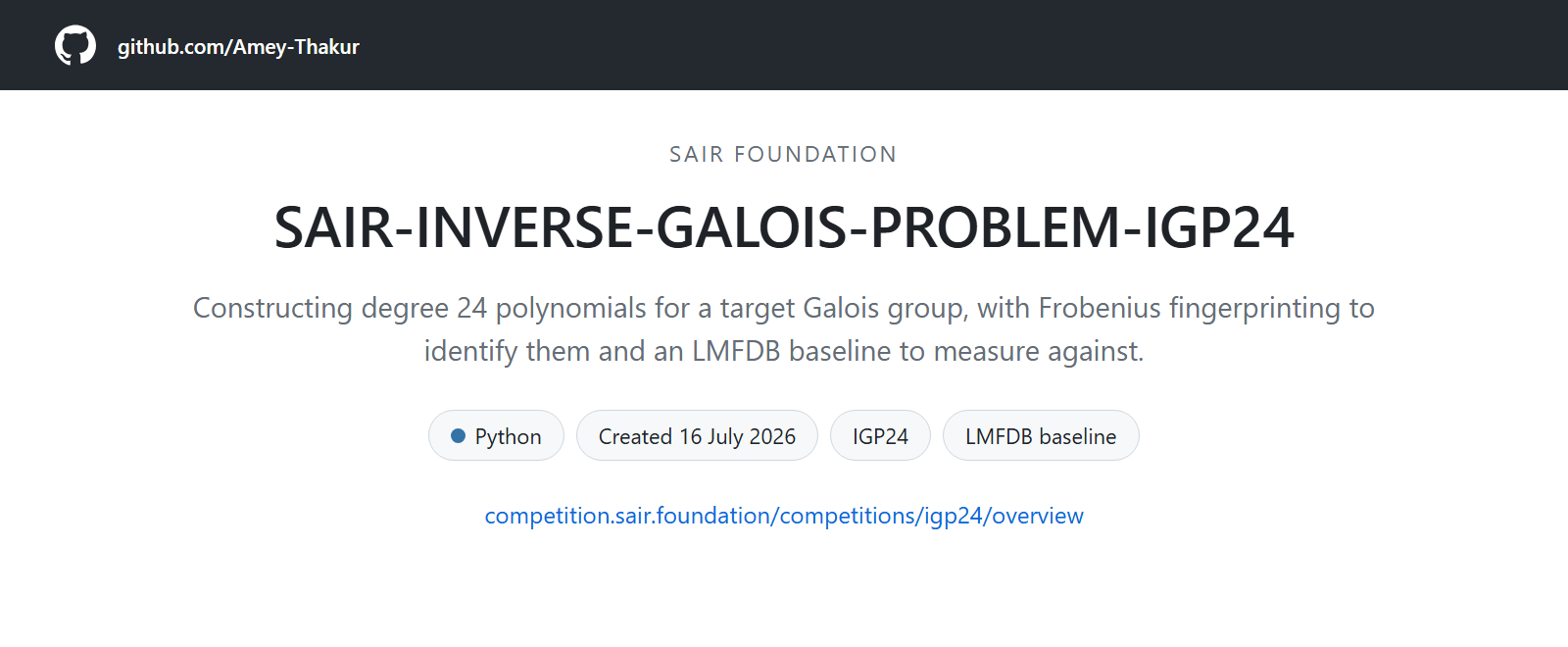
A century-old open problem, approached from the one direction a computer is good for: construction and search.
Reading them in sequence made plain something no single one of them shows. The coursework is not the early work and the projects the later work. They interleave throughout, and the habits that make the recent repositories legible were learned writing up labs that nobody required to be written up well. What changed over seven years is less the standard than the range of things it gets applied to.
What I gave every repository today
Three files. None of them is written for a human reader.
| File | Written for |
|---|---|
llms.txt | A language model arriving cold. What this is, who wrote it, what is inside, the subject terms. |
codemeta.json | Machine-readable provenance in schema.org form, carrying the creation date and the keywords. |
CITATION.cff | An identifiers entry recording when the work was created, kept separate from when it was released. |
This follows directly from the reach argument. A README is written for someone who has already arrived. Increasingly the first arrival is not a person but a model answering somebody’s question, holding a few hundred tokens in which to decide whether this work is worth citing. A page written for a human skim is not the same artefact as an index written for that decision, and the second is now part of what it means for work to be usable by a stranger.
llms.txt is one attempt at it. CodeMeta is the older and more serious attempt at machine-readable provenance, and Citation File Format is what GitHub already reads to render a citation box.
They went up in a deliberate order: undergraduate coursework in curriculum order, then the master’s, then everything after graduation. Not upload order, because most of the bachelor’s work reached GitHub years after it was done, in a batch, and upload order would have told a story that never happened.
Three things a day of reading taught me
Public work fails without ever turning red. A link that now resolves to a parked domain. A badge pointing at a service returning 503. A count that was true when it was typed. Nothing errors. The page renders perfectly, says something false, and keeps saying it until somebody reads it, which for most repositories is never. Decay in published work is silent by construction, so it has to be audited on a schedule rather than noticed by accident. Today was that audit, and it was overdue by years.
The order work is presented in is itself a claim. GitHub sorts a profile by last push, so sweeping in curriculum order turns the feed into a chronology: second year at the bottom, current work at the top. Left alone, the same feed tells a different story, ordered by whichever file was touched last, which is a story about my week rather than about the work. Either way something is being said about you. Only one of the two versions is chosen.
What is typed by hand goes stale; what is generated does not. Every number written into a README by hand has eventually become wrong. The figures in this post were read from the API today, 5 September 2026, and they will drift. The dates will not, which is why the dates carry the argument and the counts only illustrate it.
To anyone still waiting
Push it in the first week.
Those 425 days were not preparation. They were a wait for a confidence that does not arrive before the work does. What ended the wait was a student web project I did not think was ready, and it became a published paper. The certainty I was waiting for showed up after the push, which is the only order in which it ever shows up.
Then make it runnable. Not polished, not impressive: runnable by someone who cannot ask you a single question. That is the entire difference between work that exists and work that travels, and seven years of my own evidence says it is worth more than any further rigour applied to something nobody can start.
And if this is one of your quiet years, the graph is measuring what you shipped, not what you became. Mine records a single repository for 2025. It was not a lost year. It was the one that made this one possible.
The people in it
Almost nothing above was done alone, and a profile is bad at showing that. A commit has one author. A paper has several, and the work usually has more people in it than either.
Mega Satish is on more of this than anyone else, and it is not close. Twelve of the papers in my record carry her name, which is more than I can count on one hand twice, and they have gone on to be read and cited well beyond anything we expected of them at the time. Her work is collected on Google Scholar and under ORCID 0000-0002-1844-9557, and it runs alongside years of coursework, projects and competitions across the whole bachelor’s and past it.
She is the most sincere person I have worked with, and the quickest to learn something she has never seen before. If you need a thing done, you go to Mega, because she will find the way through whatever is in the way, usually before anyone else has finished describing the problem. A great deal of what is indexed under my name is work we did together, and the parts I am proudest of are the parts we disagreed about first.
Hasan Rizvi co-authored three of those papers, collected on his Google Scholar, and is the other half of that pair.
Where Mega will work a problem until it gives way, Hasan will make you understand it. He has a better command of language than anyone I studied with, he is a strong engineer, and he has the rarer skill of explaining a concept so that it stays explained. If you need something understood, you go to Hasan. A lot of what I know, I know because he took the time to say it a second way.
Between them they cover the two halves of any hard problem: someone who can figure anything out, and someone who can explain anything.
Archit Konde I met in undergraduate. We wrote Fundamentals of Neural Networks together, which is the most widely read and cited thing either of us has published and sits at the top of his Google Scholar, and then, some years later, we both moved to Canada, to the same university, and finished a master’s there as well. Two countries and two degrees is a long time to keep showing up for someone else’s half-finished work.
He is the strongest mathematician I know personally: algorithms, calculus, physics, and a genuine command of how programming languages actually work rather than how they are used. His mental arithmetic is faintly ridiculous. A good deal of what I understand about all of it came out of arguing it through with him, and he has the quality that matters more than any of the rest, which is aim. He will stay with one problem until it gives, long past the point where most people have decided it was not that interesting anyway.
He is also the person I take unfinished things to, because he will say plainly when something is not ready. Almost everyone is kind instead. Much of what is in this account is better because he was willing to be the exception.
Karan Dhiman co-authored two papers with me during the bachelor’s, collected on his Google Scholar.
He makes work worth looking at, which is a different skill from making it work, and a rarer one among engineers. Videos, presentations, posters, Canva layouts, anything in the Adobe suite: he produces them quickly, to a professional standard, and with an eye for composition that no template supplies. What would cost me an afternoon of nudging boxes into place, he has finished before I have fully explained what I want, and the result is better than the one I had pictured. If you need work to be seen, you go to Karan.
Jason Horn, at the Writing Support Desk of the University of Windsor, taught me academic writing properly: structure, citation, and the discipline of claiming only what you can support. Nearly every rule I now apply without thinking about it, I learned in those sessions. WRITING-SUPPORT exists because what he taught was worth passing on rather than keeping.
And to everyone else whose work ended up inside a repository with only my name on the commit: it was never mine alone.
If you got this far
You are past four thousand words about somebody else’s repositories, so here is the part I would only tell someone who finished.
None of this was a plan. There was no strategy behind the seven years, no decision in 2019 about what the account should become. What actually happened is that I kept putting things where other people could see them, mostly before I felt ready, and the work slowly organised itself around that habit. The narrative in this post is real, but I found it today, by reading. I was not following it at the time.
That is the thing worth passing on, and it is the opposite of what these posts usually say. You do not need the plan. You need somewhere to put the work and the willingness to put it there early, and the shape shows up later, on a day like this one, when you finally sit down and read the whole thing back.
So the honest closing line is not a conclusion. Seven years in, the useful question is still the same one it was at the start: what is the next thing, and where can somebody else find it.
If you build something and I can run it, send it to me. There is a connect page on this site, which is a short form that reaches me directly and nothing else: no list, no newsletter, no reply from anybody but me. I read every message that arrives, and the best part of publishing in the open has always been the people who write back.
The journey is not finished. It never gets to be a destination, and I have stopped wanting it to be.
Where to look
How to cite this
Thakur, A. (2026). Seven Years, and the Work That Travelled Furthest.
Amey's Arc. https://amey-thakur.github.io/posts/2026-09-05-seven-years-and-the-work-that-travelled-furthest/
@misc{thakur2026sevenyears,
  author       = {Thakur, Amey},
  title        = {Seven Years, and the Work That Travelled Furthest},
  year         = {2026},
  month        = {September},
  howpublished = {Amey's Arc},
  note         = {Written on the seventh anniversary of the account, 5 September 2026},
  url          = {https://amey-thakur.github.io/posts/2026-09-05-seven-years-and-the-work-that-travelled-furthest/}
}
The work that travels is the work a stranger can start without asking you anything.
– Amey Thakur