In one paragraph
Most software is assembled rather than written. A modern application pulls in hundreds of packages that somebody else maintains, and a scanner checks that list against databases of known vulnerabilities. Google maintains one of the most widely used of these, OSV-Scanner [1], which reads from the Open Source Vulnerabilities database [2]. I found a way to stop it dead using a single string of text, reported it, wrote the fix, and Google merged it on 2 September 2026.
The part that matters if you do not write Go
Before OSV-Scanner can tell you anything about a package, it reads that package’s own description of itself. That includes the licence: MIT, Apache-2.0, and so on.
That description is written by whoever published the package. It is not written by you, and it is not written by Google. In security terms it is untrusted input, which is a phrase worth unpacking: it does not mean the data is probably malicious, it means nothing prevents it from being. Any code that reads it has to survive the worst string somebody could put there.
Licences can be combined, and the format that expresses this is a published standard, SPDX licence expressions [3]. It allows brackets for grouping, in the same way arithmetic does:
(MIT OR Apache-2.0) AND (BSD-3-Clause OR GPL-2.0)
To read that, the parser opens a bracket, works out what is inside, then comes back out. Reading something by stepping into it and coming back out is called recursion, and it is completely ordinary.
The problem is what happens when you never come back out. Every step inward consumes a little of a fixed budget of memory called the stack. Nothing in the parser counted the steps, and nothing in the file format limits how many brackets a licence string may contain. So a string that is nothing but three megabytes of open brackets walks the parser inward until that budget is gone.
In many languages, running out of stack raises an error the program can catch
and recover from. In Go it does not. It is a fatal error: the runtime prints
fatal error: stack overflow and kills the process outright.
That distinction is the whole vulnerability. A scanner that crashes on one bad package does not skip it and continue with the rest. It ends the entire run. If your deployment pipeline requires a clean scan before shipping, a single crafted dependency anywhere in your tree stops the pipeline, and the failure looks like a broken tool rather than an attack.
The formal name for this class is CWE-674, uncontrolled recursion [4].
The stack is not unbounded and it is not extended forever: Go grows a goroutine stack on demand up to a ceiling, and exceeding that ceiling is the fatal error described above rather than a recoverable condition [5].
The code
Here is the mechanism, from internal/spdx/satisfies.go. The parser is a
recursive descent: parseOr calls parseAnd, which calls parseExpression,
and parseExpression calls back into parseOr whenever it meets an opening
bracket.
if next == "(" {
    expr, err := parseOr(tokens)
    if err != nil {
        return nil, err
    }

    if tokens.peek() != ")" {
        return nil, errors.New("missing closing bracket")
    }
    ...
}
That is the entire loop. Read it as a cycle: every ( in the input adds one
more frame to the stack, and there is no counter anywhere in the cycle. The
input decides the depth.
Reproducing it takes one line:
strings.Repeat("(", 2_000_000) + "MIT" + strings.Repeat(")", 2_000_000)
The fix
Forty lines across two files, and none of them are clever. That is the point: the bug was not subtle, it was simply unstated.
First, a ceiling, written down with the reasoning next to it rather than as a bare number:
// maxDepth bounds how deeply nested the parser will recurse into bracketed
// sub-expressions. License expressions are supplied by scanned package
// metadata, which is untrusted; without a limit a deeply nested expression
// (e.g. many "(") recurses until the goroutine stack overflows, which is a
// fatal error that recover cannot catch. Real SPDX expressions nest only a
// handful of levels, so this ceiling is far above any legitimate input.
const maxDepth = 1000
Then a counter on the token stream itself, so the depth travels with the parse rather than being threaded through every function signature:
type tokens struct {
	tokens []string
	depth  int
}
And the check, at the one place the parser descends:
if next == "(" {
    tokens.depth++
    if tokens.depth > maxDepth {
        return nil, fmt.Errorf("license expression nested too deeply (limit %d)", maxDepth)
    }

    expr, err := parseOr(tokens)
    if err != nil {
        return nil, err
    }
    tokens.depth--
    ...
}
Two details in that small block are worth naming.
The decrement matters as much as the increment. Without tokens.depth-- on
the way out, a long run of sequential, non-nested brackets like (MIT) (MIT) (MIT) would accumulate depth it never actually used, and a legitimate
expression would eventually be rejected. Depth is about how deep you currently
are, not how many brackets you have seen.
The failure is ordinary. It returns a normal parse error, the same kind the parser already returns for a missing closing bracket. Nothing special-cases it, nothing logs a warning about attacks, and the scan moves on to the next package. A security fix that introduces a new failure mode has traded one problem for another.
The ceiling of one thousand is deliberately generous. The most complicated licence expressions in real circulation nest a handful of levels. Nothing legitimate comes close, so no valid input is rejected to buy this.
The test
A fix for a crash is only worth what its regression test is worth, and this one has an unusual property: without the fix, it does not fail, it terminates the test binary.
func TestSatisfies_DeeplyNested(t *testing.T) {
	t.Parallel()

	// A license expression is untrusted input taken from scanned package
	// metadata. Deeply nested brackets must be rejected with an error rather
	// than recursing until the goroutine stack overflows, which is a fatal
	// error that recover cannot catch.
	license := models.License(strings.Repeat("(", 2_000_000) + "MIT" + strings.Repeat(")", 2_000_000))

	got, err := spdx.Satisfies(license, []string{"MIT"})

	if got {
		t.Errorf("Satisfies(deeply nested) = %v, want %v", got, false)
	}

	if err == nil {
		t.Fatal("Satisfies(deeply nested) = nil error, want a nesting-limit error")
	}

	if !strings.Contains(err.Error(), "nested too deeply") {
		t.Errorf("Satisfies(deeply nested) = %v, want a nesting-limit error", err)
	}
}
Two million levels, which is two thousand times the ceiling, so there is no argument about whether the limit is doing the work. With the fix it passes in under half a second, because the parser stops at level one thousand and never allocates the remaining 1,999,000.
The boundaries were checked separately: shallow nesting parses, nesting exactly at the ceiling parses, one level past fails cleanly, and sequential non-nested brackets do not accumulate depth.
Contributing it upstream
This is the part people ask about most, so it is worth writing down plainly.
I filed an issue before writing any code. Issue #2993 [8], with a reproduction. For anything with a security shape this order matters: it lets the maintainers decide whether the finding needs a private advisory before any of it becomes public. Opening a pull request first would have published the reproduction and taken that choice away from them.
They judged it and assigned it back. The maintainers looked at it, concluded it was ordinary hardening rather than an embargoed vulnerability, and assigned the implementation to me. That is a good outcome: the fix was wanted before it was written.
The Google CLA. A contributor licence agreement [7] is required for any contribution to a Google-maintained repository. It is a one-time signature and takes a couple of minutes.
Review and merge.
Pull request #3032 [10] went
through review and merged into main on 2 September 2026, and the issue closed
as completed the same minute.
Where it stands today. The fix is on main but not yet in a tagged release.
The newest release as I write is v2.5.1 from 17 August 2026, which predates the
merge. If you need it now, build from main; otherwise it arrives with the next
release.
What I took from it
The bug was not hiding in anything clever. There was no subtle concurrency problem, no exotic use of the type system, no cryptography. It sat at the boundary where somebody else’s data becomes your control flow, which is where a great many of them sit.
Recursive descent is the normal way to write a small parser and it is a good default [6]. Its failure mode is simply that the input decides how deep you go. Any code that walks user-supplied structure is making a promise about depth that it has usually not written down: nested JSON, a linked object graph, a path expression, a template that can include another template. Writing the promise down costs a counter and a constant.
The second lesson is procedural, and it saved more time than the code did. Reporting first and implementing second cost a few days of waiting and made the entire exchange straightforward. The maintainers knew what was coming, had already agreed it was worth fixing, and reviewed a change they had asked for.
Figures and media
The animation is published in three renderings, generated from a single frame list so that none of them can disagree with the others. All are 1080 x 1080 and all are held in this article’s own folder.
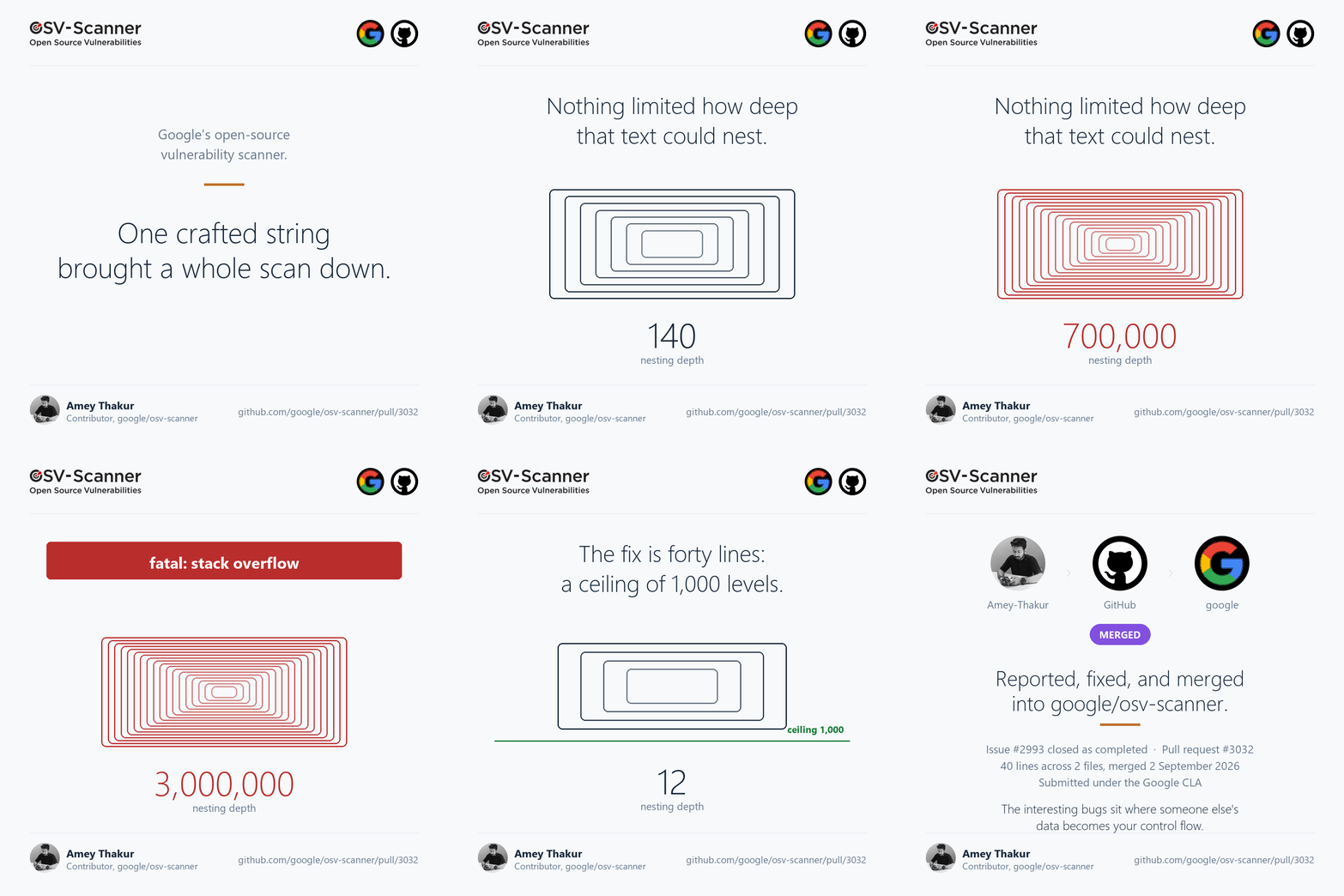
Figure 1. The full explainer, four beats, 26.6 seconds.
Also available as H.264 video and as an animated GIF.

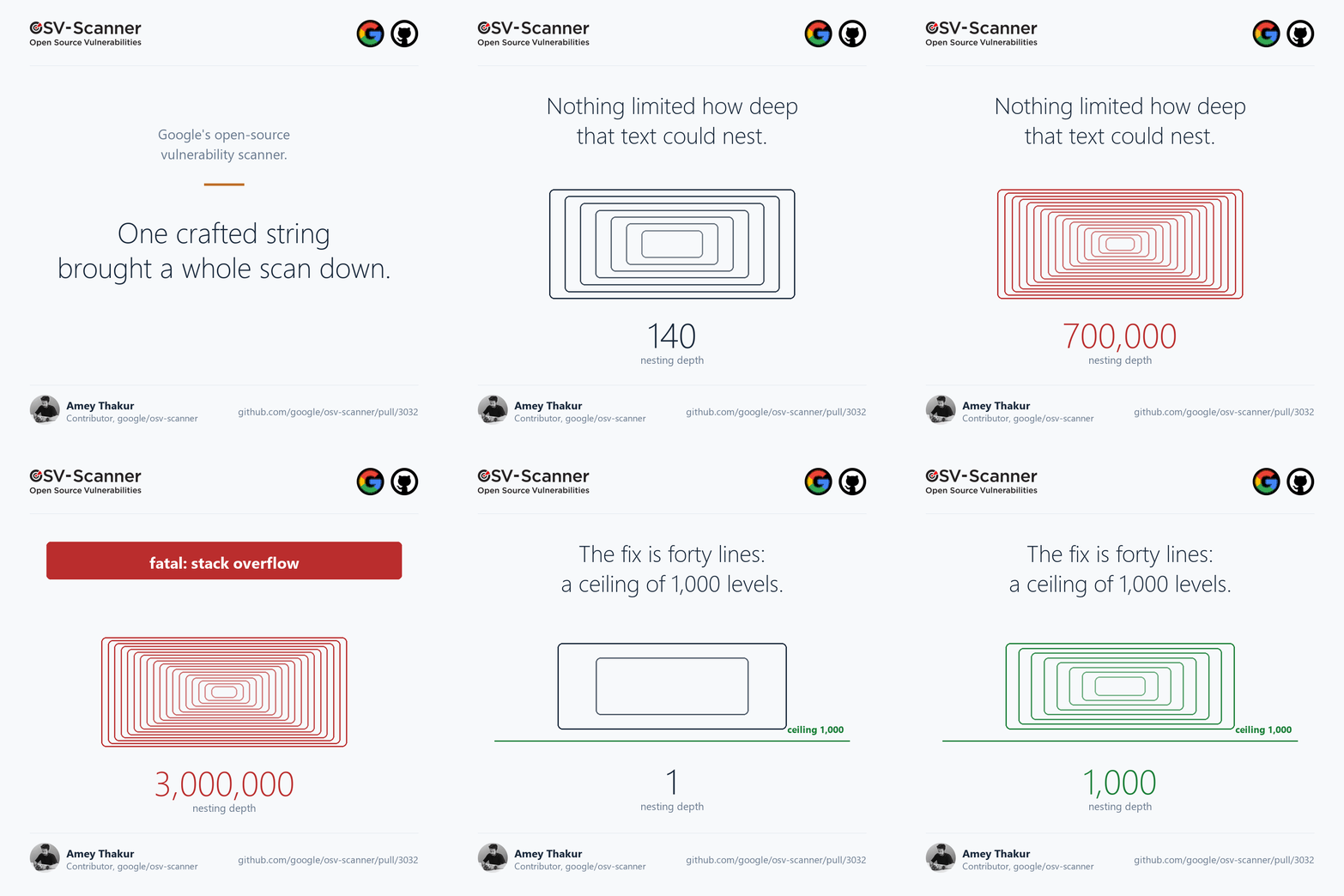
The visual grammar is literal rather than decorative. The rectangles closing inward are the nesting itself, one rectangle per level of bracket, and the figure beneath them is the depth the parser was tracking as it descended. The frame turns red at the point the stack is exhausted and green at the point the ceiling stops it, and those are the only two uses of colour in the sequence.
| Beat | Content |
|---|---|
| 1 | What OSV-Scanner is, and the claim: one crafted string ended a scan |
| 2 | It reads a licence string from every package, and nothing limited how deep that string could nest. The counter runs to three million and the frame turns red |
| 3 | The ceiling at one thousand. The same climb, stopped cleanly, in green |
| 4 | Merged, with the issue, the pull request and the dates |
Figure 2. The crash and the fix only, trimmed to loop, 6.5 seconds.
The same three files are mirrored on the
media branch of the
fork [9], an orphan branch that shares no history with main or with the branch
that was merged, so that neither carries assets which were never part of the
change.
References
- Google. OSV-Scanner: vulnerability scanner for open-source dependencies. GitHub repository. https://github.com/google/osv-scanner Documentation: https://google.github.io/osv-scanner/
- Open Source Vulnerabilities. OSV: a distributed vulnerability database for open source. https://osv.dev/
- The Linux Foundation. SPDX Specification v2.3: SPDX licence expressions. https://spdx.github.io/spdx-spec/v2.3/SPDX-license-expressions/
- MITRE. CWE-674: Uncontrolled Recursion. Common Weakness Enumeration. https://cwe.mitre.org/data/definitions/674.html
- The Go Authors. Package runtime/debug: SetMaxStack. Go documentation. https://pkg.go.dev/runtime/debug#SetMaxStack
- Aho, A. V., Lam, M. S., Sethi, R., and Ullman, J. D. Compilers: Principles, Techniques, and Tools. 2nd edition, Addison-Wesley, 2006. Chapter 4, on recursive-descent parsing.
- Google. Google Contributor Licence Agreements. https://cla.developers.google.com/
- Thakur, A. spdx.Satisfies: unbounded recursion causes uncatchable stack overflow on deeply nested license expressions. Issue #2993, google/osv-scanner, filed 2026. https://github.com/google/osv-scanner/issues/2993
- Thakur, A. Amey-Thakur/osv-scanner. Fork of google/osv-scanner, carrying the submitted branch
fix/spdx-recursion-depth-limit, the working record in Discussion #1, and themediabranch. https://github.com/Amey-Thakur/osv-scanner Discussion: https://github.com/Amey-Thakur/osv-scanner/discussions/1 - Thakur, A. fix(spdx): bound recursion depth when parsing license expressions. Pull request #3032, google/osv-scanner, merged 2 September 2026. https://github.com/google/osv-scanner/pull/3032 Merge commit
1c93dc4
How to cite this
Thakur, A. (2026). A stack-overflow denial of service in Google's OSV-Scanner.
Amey's Arc. https://amey-thakur.github.io/posts/
2026-09-02-a-stack-overflow-denial-of-service-in-googles-osv-scanner/
@misc{thakur2026osvscanner,
  author       = {Thakur, Amey},
  title        = {A Stack-Overflow Denial of Service in Google's {OSV-Scanner}},
  year         = {2026},
  month        = {September},
  howpublished = {Amey's Arc},
  note         = {Fixed in google/osv-scanner pull request 3032, merged 2 September 2026},
  url          = {https://amey-thakur.github.io/posts/2026-09-02-a-stack-overflow-denial-of-service-in-googles-osv-scanner/}
}
The working record, including the review trail and the three renderings above, is in the discussion on my fork [9].