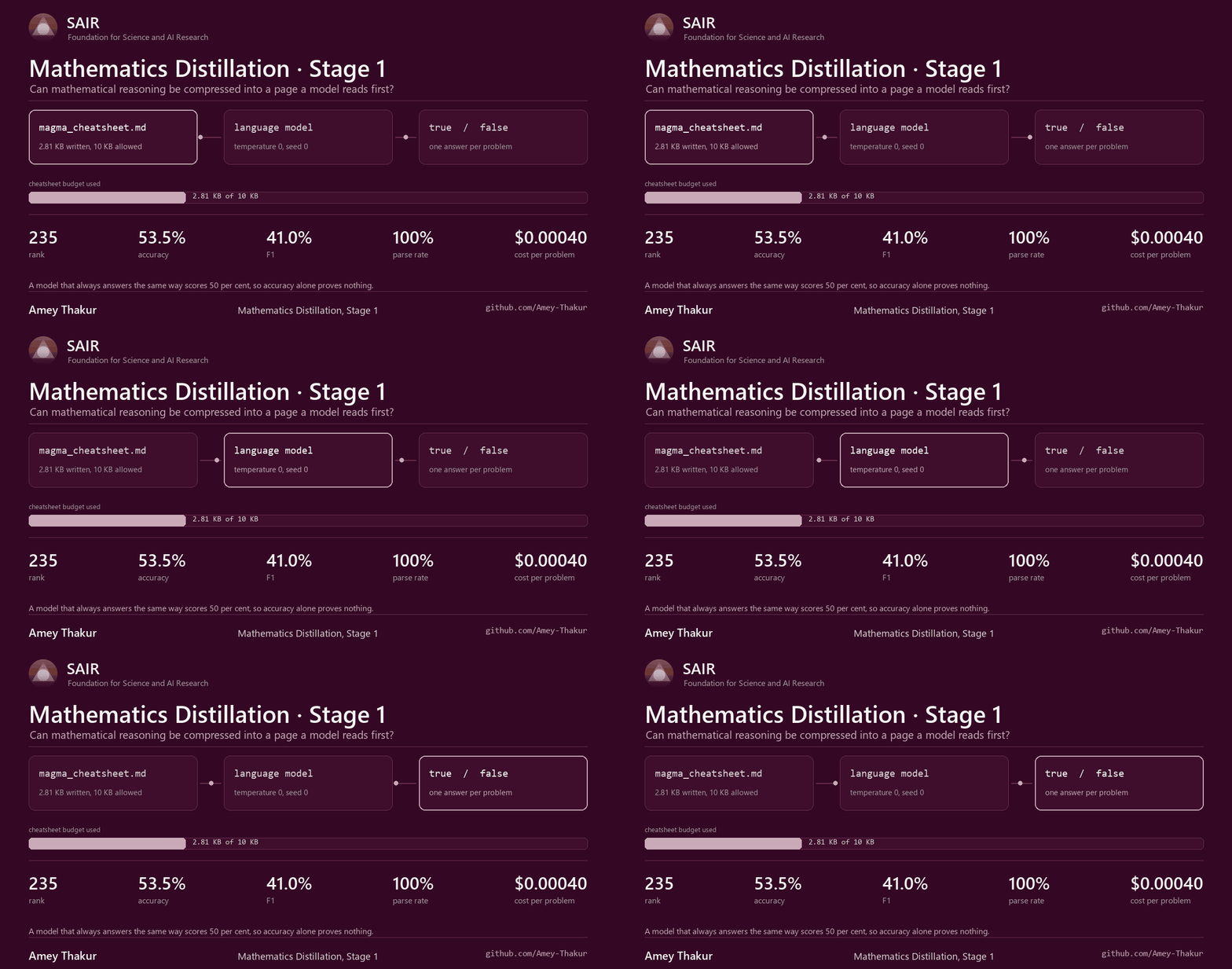
Stage 1. One page of distilled mathematics, a model, and a yes or no.
A model that scored fifty per cent and knew nothing
Start with the detail that reorganised how I think about evaluation.
Stage 1 of this competition asked a language model a series of true-or-false questions about algebra, and the evaluation set was deliberately balanced, half true and half false. One of the three models scored close to fifty per cent accuracy. It parsed every prompt correctly. It answered in the right format every time.
Its F1 score was near zero, because it had answered the same way on every single question.
Fifty per cent looks like a model that half understands. It was a model that understood nothing and had found the one strategy a balanced set rewards for free. Accuracy alone cannot tell a reasoner from a coin, and I have never seen that demonstrated so cleanly.
The problem underneath
A magma is the least structured object in algebra: a set with one operation
and no rules at all. No associativity, no identity, no inverses. Because so
little is assumed, a law like x = x ◇ y constrains it only lightly, and
working out what else that law forces is genuinely hard.
The Equational Theories Project [1] took the 4,694 simplest such laws and asked, for every ordered pair, whether the first implies the second. That is 22,033,636 questions, settled in Lean 4 through a mix of automated search and human proof.
This competition asked something different about the same material:
Can strong mathematical reasoning be distilled into a compact artefact that makes a language model better at a formal task?
It was organised by Damek Davis, Associate Professor of Statistics and Data Science at the University of Pennsylvania, and Terence Tao, with the SAIR Foundation [2]. The setup follows the cheat-sheet distillation of Honda, Murakami and Zhang [3], with the artefact discovered by open competition rather than produced by a single model query. Two hundred and ninety-four people took part.
Stage 1 launched on 14 March 2026 at 15:09:26 in UTC+14, the earliest place on Earth to reach the time 3.1415926. I mention it because a competition that goes to that trouble is telling you something about the people running it.
Stage 1, and why it could be gamed
You submit a complete prompt: the template and a cheatsheet, together at most 10 KB, exactly as it will be sent. The model answers true or false. Only correctness is scored. No browser, no search, no retrieval.
Ten kilobytes is not much. It is roughly this article, up to here, and into it has to go whatever a model needs to reason about laws it has never seen.
But re-read that scoring rule. Only correctness is scored. A model that is fluent and wrong scores exactly what a model that is careful and wrong scores, and the constant-answer strategy above shows how far that can be pushed without any reasoning at all.
Stage 2, which closes the door
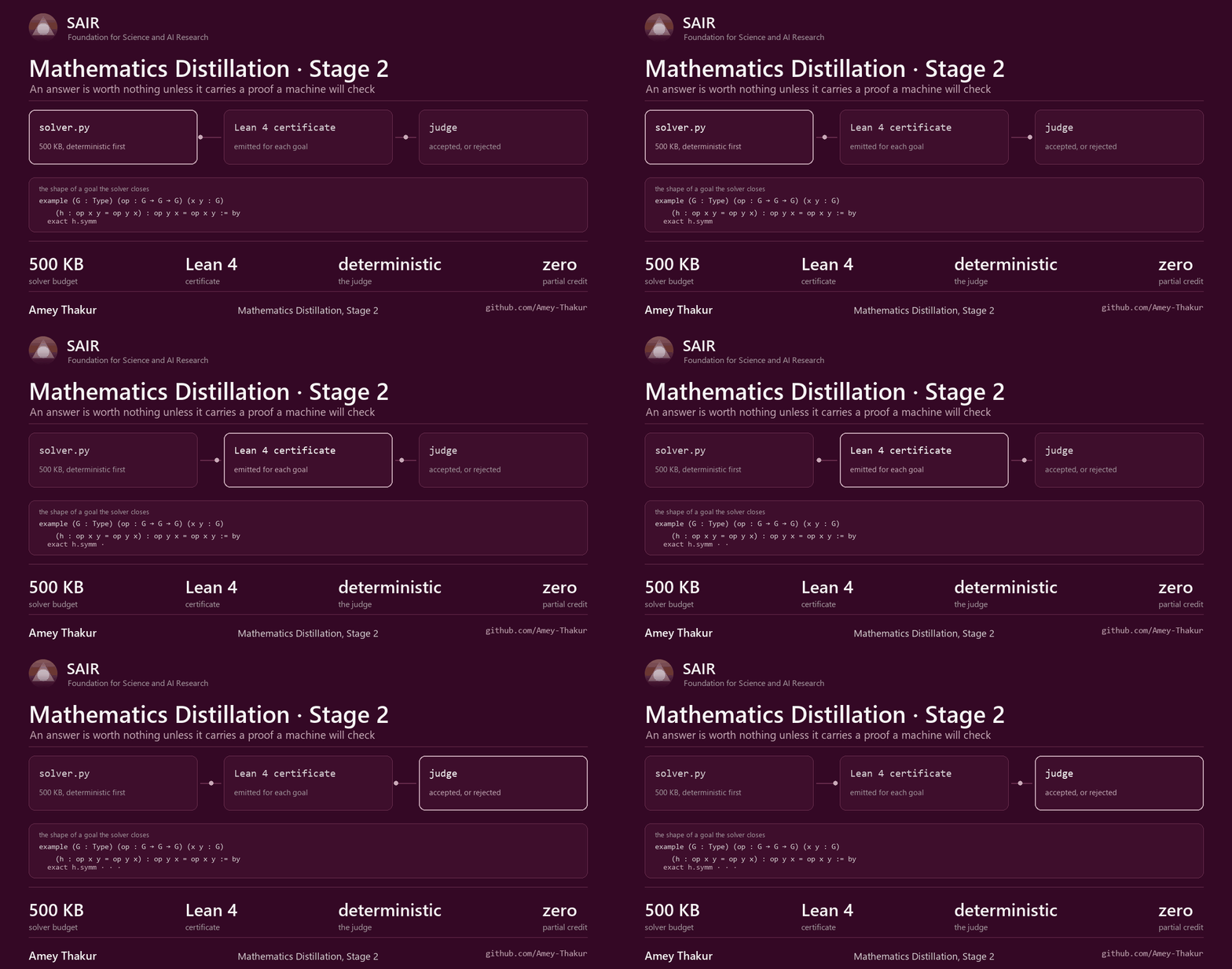
Stage 2. The answer is worth nothing without a certificate a machine will check.
Stage 2 replaces the answer with a certificate.
You submit one solver.py, at most 500 KB. For every pair of equations it must
produce something a Lean 4 [4] judge will verify:
| Verdict | What you must actually produce |
|---|---|
| True | A Lean 4 proof that the hypothesis forces the goal in every magma |
| False | A concrete magma where the hypothesis holds and the goal fails |
The judge is deterministic. There is no partial credit. A confident wrong answer now scores exactly zero, and so does a correct answer you cannot prove.
This is the same design idea as the Modular Arithmetic Challenge I wrote about earlier this month: rather than forbidding the shortcut, build an interface where the shortcut cannot be expressed. There, no part of your code ever saw the whole question. Here, no claim counts until a machine has checked it.
What I built, and why it runs backwards
The obvious solver asks a model to write the Lean proof and hopes the judge agrees. Model-written Lean is wrong often enough that a large share come back rejected, and every rejection has already been paid for in tokens.
Mine inverts the order. It proves what it can without the model, and every deterministic answer is verified locally before it is ever sent.
Counterexamples are cheap and certain. Orders 2 and 3 exhaustively, affine magmas to order 8, order 4 by constrained backtracking, filtered random tables at 5 and 6. Every witness is checked in Python first, so the judge only confirms something already established.
Some true implications need no model either. If the hypothesis forces every
element to be equal, one line closes any goal. Beyond that, a rewrite prover
simulates Lean’s rw exactly and searches short chains in both directions, and a
saturation pass derives helper lemmas and proves them before using them.
The verdict is known before the search begins. The Equational Theories outcome matrix is embedded in the solver, compressed to about 32 KB by collapsing 4,694 equations into 1,415 classes with identical implication behaviour.
The model is the last resort, called only for true implications that survived every deterministic stage.
On the official 20-problem sample, the deterministic stages alone answer 15, with no tokens spent and no incorrect certificate produced.
The property I am most pleased with is that the embedded verdict table steers the budget and nothing else. If it is wrong, or misses, it cannot produce a wrong answer, because every certificate is still verified locally before it is sent. A lookup table that can only waste time and never mislead you is a safe thing to carry.
The failure mode that would have cost everything
The evaluation sandbox is python:3.12-slim, with no third-party packages and
no network.
A solver that imports numpy does not run slowly. It does not answer badly. It
dies on import, before the first problem, and every answer in the run is lost.
Nothing in local testing reveals this, because locally the packages are installed. So it is enforced in continuous integration instead: a check that holds the solver to the sandbox rules and the size cap, and a second that re-parses every emitted certificate from its Lean source and re-verifies it, both running with no Lean toolchain at all.
If you take one practical thing from this post, take that. The environment your code will die in should be a test, not a hope.
What the two stages taught me together
Stage 1 asks whether reasoning can be compressed. Stage 2 asks whether the thing that came out the other end was reasoning at all.
Between them they draw a line I now use elsewhere. A system that produces answers can be evaluated only statistically, and statistics can be gamed by a constant function. A system that produces checkable artefacts can be evaluated one item at a time, by a machine, with no benefit of the doubt available anywhere.
Certificates are more work. They are also the only version of this where being confidently wrong costs you exactly what it should.
Where the work is
References
How to cite this
Thakur, A. (2026). When an Answer Stops Being Enough.
Amey's Arc. https://amey-thakur.github.io/posts/
2026-08-31-when-an-answer-stops-being-enough/
@misc{thakur2026distillation,
  author       = {Thakur, Amey},
  title        = {When an Answer Stops Being Enough},
  year         = {2026},
  month        = {August},
  howpublished = {Amey's Arc},
  note         = {Written for the SAIR Foundation Mathematics Distillation Challenge, Equational Theories, Stage 2, submissions closed 31 August 2026},
  url          = {https://amey-thakur.github.io/posts/2026-08-31-when-an-answer-stops-being-enough/}
}
A confident answer and a correct one are different products. Only one of them can be checked.