Twenty-five thousand groups. The competition asks for a polynomial that realises each one.
An open problem you can attack with a laptop
Most famous unsolved problems in mathematics cannot be attacked by anyone without a decade of specialist training. The inverse Galois problem is unusual, because one slice of it turns into something a search can bite on.
The problem asks whether every finite group is the symmetry group of some number field. Nobody knows. But you can ask it one degree at a time, and then it becomes concrete:
For every transitive permutation group on 24 letters, find an irreducible integer polynomial of degree 24 whose Galois group is that group.
There are 25,000 such groups, labelled 24T1 through 24T25000. Each one
can appear with several signatures, counting how many of its roots are real, and
across all of them that gives 165,836 possible targets.
Everything below degree 24 is essentially finished. Every transitive group of
degree 22 or less has a known realisation, and degree 23 has exactly one holdout,
the Mathieu group M23. Degree 24 is wide open. The frozen baseline this
competition started from, drawn from the LMFDB, covered
286 labels and 622 pairs, which is under half a per cent of the surface.
The competition was IGP24 [1], run by the SAIR Foundation in collaboration with the LMFDB [2], co-organised by John Jones, Jen Paulhus, David Roe, Andrew Sutherland and Terence Tao. Two hundred and fifty-six teams entered. Submissions closed today.
There is a theorem in the background that makes the gap sharper. Shafarevich proved that every finite solvable group does occur as a Galois group over the rationals [3], and 24,193 of these 25,000 groups are solvable. So the existence question is largely settled. What nobody has is the polynomials. The theorem does not hand them over, and that is exactly the gap the competition exists to close.
The scoring rule, which is the whole strategy
A submission is a plain text file. Each line is 25 integers, the coefficients of a monic degree-24 polynomial. At most 1,000 per submission, 200 submissions a day. An official verifier computes the real answer.
You might reasonably assume the goal is volume. It is not, and the scoring makes
that mathematically precise. For a pair held by k teams, your score is
proportional to 2^(1 − k).
| Who holds the pair | What it is worth |
|---|---|
| Only you | 1 point |
| Two teams | about 0.5 each |
| Ten teams | about 0.002 each |
A pair held by ten teams is worth roughly one five-hundredth of a pair held alone. Discriminant size applies a mild adjustment on top, and ties pay nothing.
Rarity is the entire game. Volume without rarity is worth almost nothing, and I want to be honest that I understood this rule before I started and still built a machine that produced volume.
The factory, and the trick inside it
I had no Magma licence, which is the standard tool for computing a Galois group label. The whole pipeline was designed around not having it: construct structured candidates, guess their group cheaply, avoid re-sending anything already held, and let the official verifier settle the label.
The cheap guess is the piece worth taking away.
Factor the polynomial modulo a fixed set of primes and collect the cycle types you see. By Chebotarev’s density theorem, that set of shapes is close to a signature for the Galois group [4]. It costs about a millisecond, against a Magma computation I could not run at all. Joined back against the labels the server returned, it matched 10,750 entries with 7 conflicts, so as a predictor it is very nearly exact.
It is also exactly the kind of tool that will lie to you if you let it.
Many distinct fingerprints collapse onto the same label, so novelty in fingerprint space badly overstates novelty in pair space. In one wave, 10,000 apparently novel clusters yielded about 771 genuinely new pairs.
A pipeline that counts clusters as discoveries will report progress it has not made. I know because mine did, until I checked it against what the server actually credited.
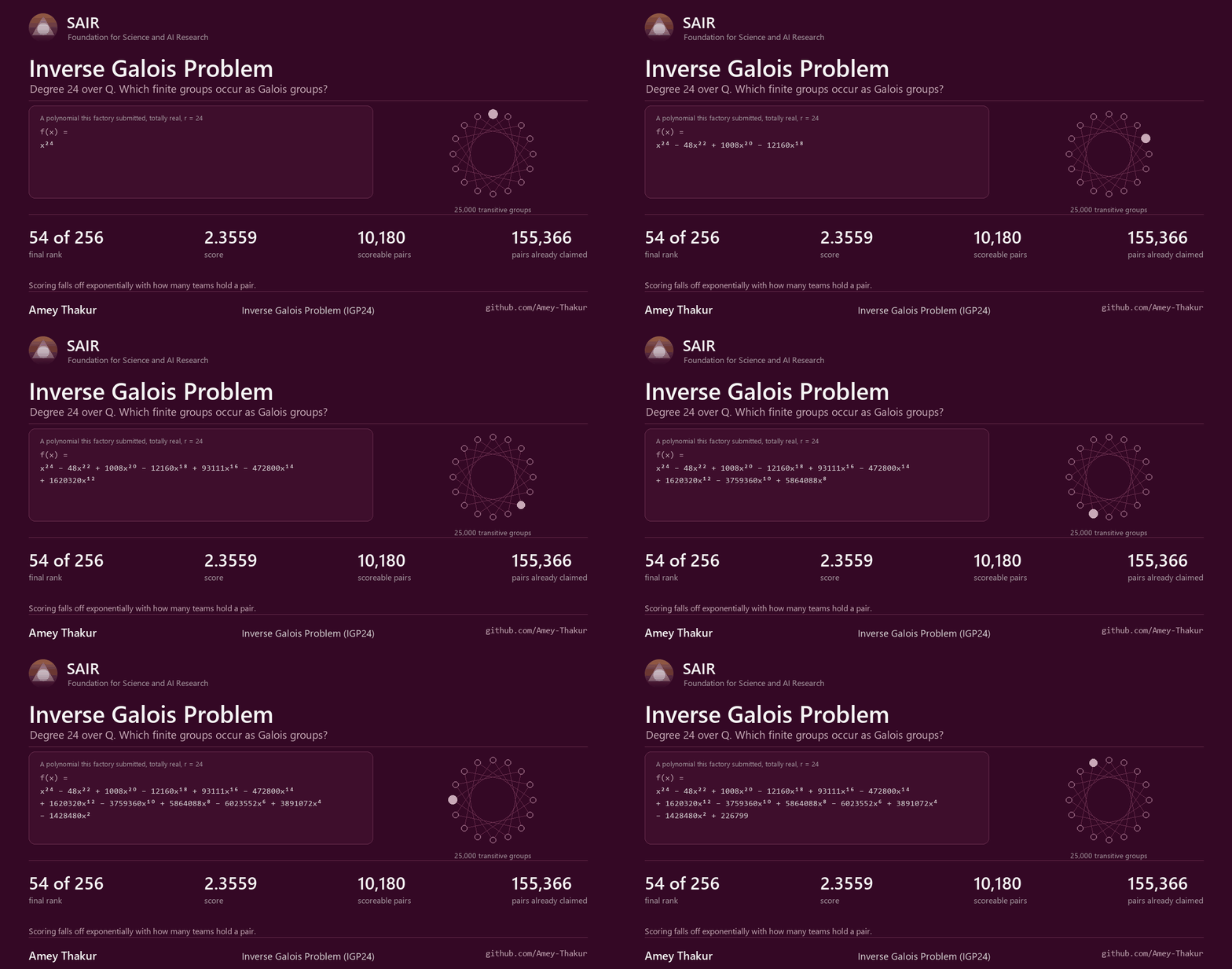
The run itself: what the factory searched, and where it finished.
The result, and it is not a good one
| Team | AVATAR, IGP24-T00178 |
| Rank | 54 of 256 |
| Score | 2.3559 |
| Scoreable pairs | 10,180 |
Ten thousand pairs and two and a third points. That ratio is the whole story, and it is not bad luck. It is the arithmetic of arriving late to a space that had already been swept.
Why, measured rather than guessed
This is the part I would keep. The most useful thing I have from three months of this is a negative result with numbers attached.
Everything reachable was already taken. As of 1 August, of the 165,836 possible pairs, 155,366 already had at least one team on them. The typical pair carried two teams. The most crowded carried 75. Every pair my factory produced landed somewhere in that mass.
The gap is constructive, not computational. About 97 per cent of my labelled output landed on high-index generic groups, which every team reaches without trying. The pairs still unclaimed sit on groups my engines simply never produce. Reaching them needs constructive Galois theory of the kind Magma provides, and no amount of additional compute substitutes for it. I was not short of cycles. I was short of constructions.
The class field theory campaign proved it exactly. Ray class field sweeps, computed with PARI/GP [5], over quartic, sextic and octic bases produced about 48,000 polynomials and 1,410 pairs. Twelve of those were nearly uncrowded, which was the first encouraging thing in weeks. All twelve were inside the frozen baseline, and on nine of them the discriminant came out exactly equal to the baseline minimum rather than below it.
Sit with that for a second. The method had independently re-derived LMFDB’s own minimal fields, to the digit. It is the most satisfying failure I have had. Unlocking a baseline pair requires strictly smaller, so all of it paid nothing.
The honest shape of the finding is this: the small-conductor class field zone is the LMFDB baseline. Tooling that reaches it arrives precisely where the ground is already occupied, and it arrives there by rediscovering what is already known.
What I would tell the next person
Grade your engines early, and drop the ones that make generic groups. This is measurable within a day. Compositum constructions put 57 per cent of their output into the useful middle band. Tower constructions managed 1.6 per cent. That difference decides the entire outcome, and I spent real time on towers before I measured it.
Distrust a cheap proxy that has never been checked against ground truth. The fingerprint was excellent and it still inflated my sense of progress by more than an order of magnitude, because it was measuring the wrong space. A proxy tells you about the thing you can compute, not the thing you are scored on.
When the scoring is exponential, read it as a constraint on the method, not on the effort. I read the rule correctly and drew the wrong conclusion from it. I optimised throughput inside a construction family that could only ever reach crowded ground. The rule was not asking me to work harder. It was telling me which mathematics I needed and did not have.
Where the work is
References
How to cite this
Thakur, A. (2026). Twenty-Five Thousand Groups, and the Ones Nobody Can Reach.
Amey's Arc. https://amey-thakur.github.io/posts/
2026-08-15-twenty-five-thousand-groups-and-the-ones-nobody-can-reach/
@misc{thakur2026igp24,
  author       = {Thakur, Amey},
  title        = {Twenty-Five Thousand Groups, and the Ones Nobody Can Reach},
  year         = {2026},
  month        = {August},
  howpublished = {Amey's Arc},
  note         = {Written for the SAIR Foundation IGP24 competition, submissions closed 15 August 2026; final standing 54 of 256},
  url          = {https://amey-thakur.github.io/posts/2026-08-15-twenty-five-thousand-groups-and-the-ones-nobody-can-reach/}
}
The method rediscovered what was already known, to the digit, and was paid nothing for it. That is still a result.