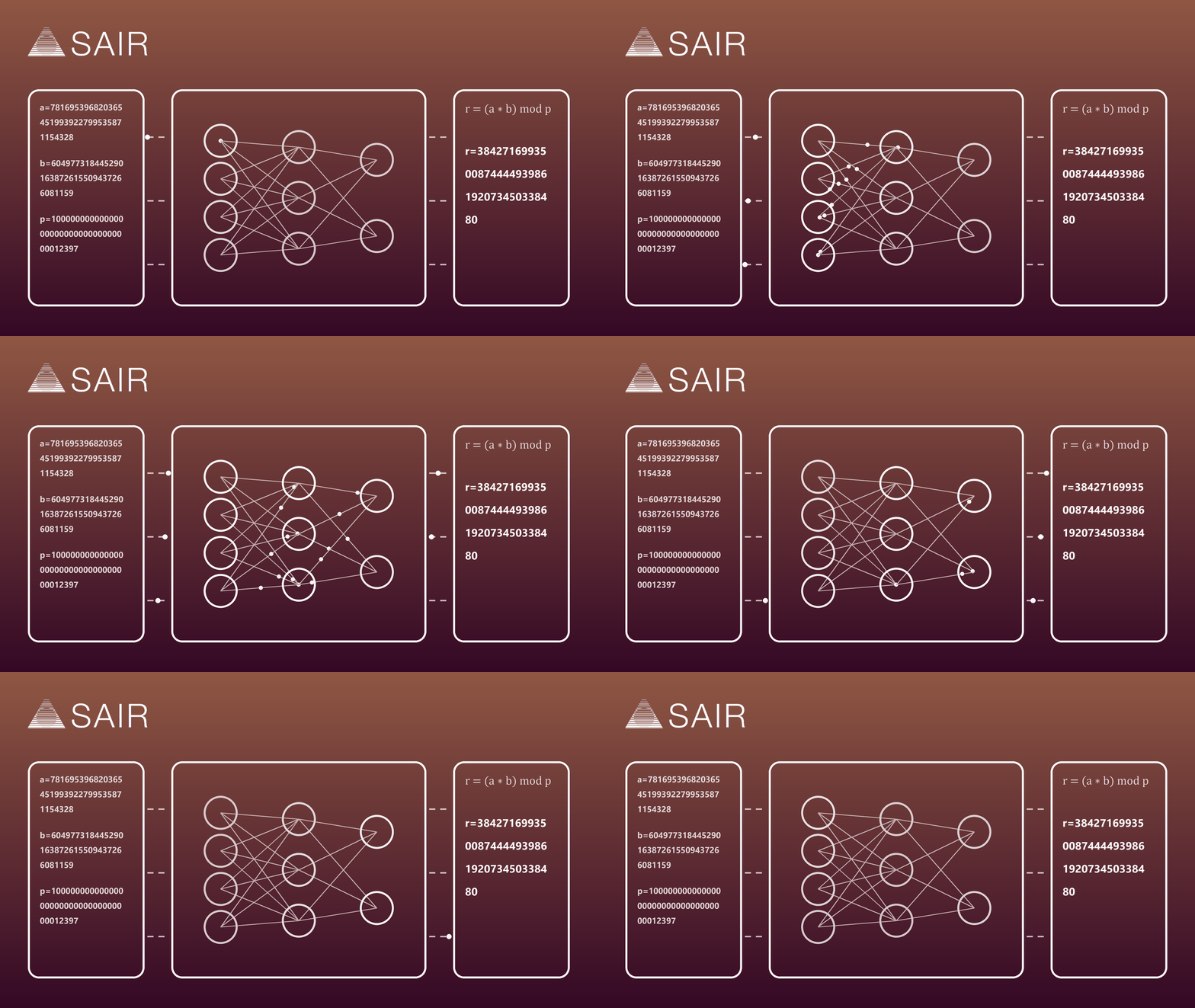
Two numbers and a prime go in. One exact remainder comes out, and nothing in the submitted code is allowed to calculate it.
The question a calculator makes look silly
Take two whole numbers, multiply them, divide by a prime, and keep the remainder. Your phone does this in less time than it takes to lift your finger.
Now make the numbers about 1,233 digits long, make the prime up to 617 digits, and ask a neural network to do it instead. Not approximately. Exactly, digit for digit, because a remainder that is off by one is not close, it is wrong.
That is the Modular Arithmetic Challenge [1], run by the SAIR Foundation from 8 June to 12 August 2026, and organised by Alberto Alfarano, François Charton, Yongzheng Jia, Kristin Lauter, Cathy Li, Terence Tao and Emily Wenger. One hundred and thirty people entered. Submissions closed today.
The reason a competition exists at all is that nobody is sure it can be done.
Why it is hard, in one paragraph you do not need mathematics for
A network that recognises a cat does not have to be exactly right. It has to be mostly right, and being mostly right about a cat is still useful. Arithmetic does not work like that. There is no partial credit for a remainder. So the network has to find an actual procedure, not a good approximation, and it has to find it on its own from examples.
Then it has to run that procedure over a thousand digits without losing its place.
| What makes it bite | Why |
|---|---|
| Carrying | A digit at one end of the number changes a digit at the far end |
| Coordination | That has to hold across every digit, at every scale, at once |
| Growing output | The answer’s length follows the input’s, so nothing is fixed width |
| Reduction | And then the remainder sits on top of all of it |
Small transformers can already learn modular addition for small primes, and when you look inside them the representations resemble Fourier analysis on a cyclic group [2], which is a lovely result. Multiplication is a different animal.
The obstacle that has nothing to do with arithmetic
This is the part I would keep if I could keep only one paragraph.
A transformer does not know where anything is unless you tell it. The standard way to tell it is by position: this digit is the first, this one is the second, this one is the seventh.
Now pad the number. Every digit moves. A model trained on short operands has never in its life encountered index 7, so when a longer number arrives, every digit it can see is at a coordinate it has no experience of.
Describe the digit by what it is worth instead, its place value, and the problem dissolves. Significance 3 is significance 3 whether the number is twelve digits long or twelve hundred. The model has seen it on every example it was ever given.
Place value is not a trick for this task. It is the only description of a digit that survives what the task does to its inputs.
That is not a machine learning insight. It is the same insight that made the abacus work, and the reason we teach children columns before we teach them carrying.
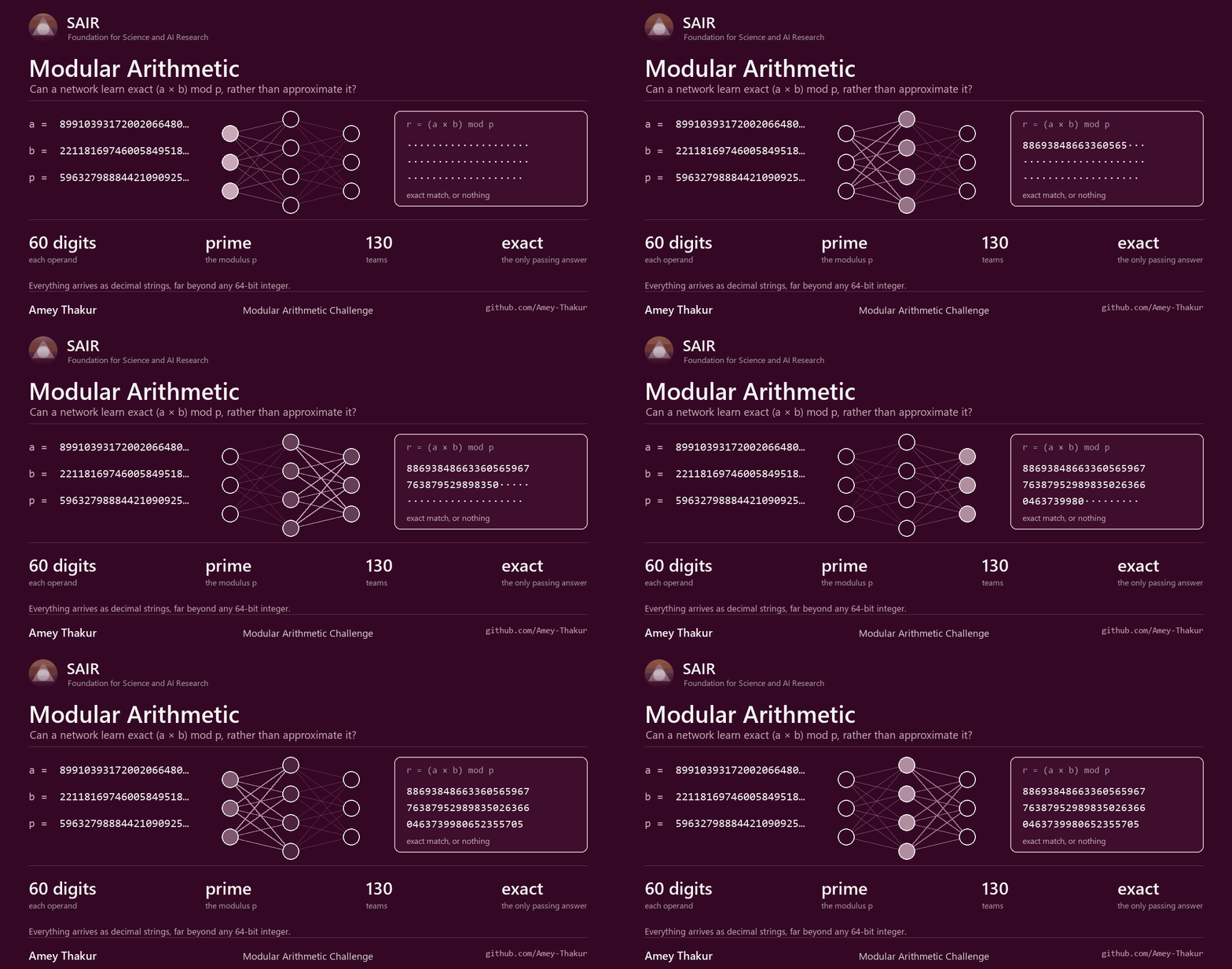
The task at the scale it is actually set: operands far longer than anything the model was trained on.
The rule that makes it a real problem
Here is the part I found genuinely elegant, and it is a design lesson rather than a mathematical one.
The obvious way to win a competition like this is to cheat: call a library, look the answer up, hard-code something. So the organisers built an interface where cheating is not forbidden so much as structurally impossible.
Your submission provides three separate preprocessing hooks, one for each input. Each hook sees only its own argument. No single point in the code you submit ever holds the two operands and the prime at the same time. The decoder that turns the model’s output back into a number belongs to the competition pipeline, not to you.
You cannot compute the answer because you are never given the question.
The explicit ban list covers the rest: no sympy, gmpy2, mpmath or Python
big integers on the original arguments at inference, no lookup tables keyed on
the inputs, no eval, no network access, no subprocesses, no leakage between
the three hooks. What remains allowed is telling: base conversion inside a
single hook, any internal representation you like, and feeding the model its
own output one token at a time.
The principle fits in a sentence. The model must learn to compute the answer, and may not delegate, look up, or hard-code it.
I have started designing my own evaluation harnesses this way. It is far easier to make the wrong answer impossible to express than to write a rule that forbids it.
What I submitted, and the four bets in it
Place-value embeddings. Drop absolute position and inject significance, for the reason above, following the abacus construction of McLeish et al. [3]. A 1,024-bit prime then travels the same path as a 16-bit one.
Algorithmic scratchpads. Force the model to write out its intermediate working [4]. This turns a fixed-depth network into something closer to a recurrent state machine, and it lets the model spend computation in proportion to the size of the number rather than in proportion to its own depth. A network that must show its working can afford a longer calculation.
Grokking. Train far past the point where the validation loss has flattened, with heavy weight decay, and wait. There is a transition, well documented since Power et al. [5], where memorised circuits collapse into the sparse algorithm underneath them. The published weights were taken after that transition rather than before it, which is a decision about patience more than about architecture.
Routing. Small and large moduli want different amounts of computation, so a light router reads the width of the prime and dispatches to a direct model or a scratchpad model accordingly.
The result is a public model on the Hugging Face Hub, identified by an immutable commit hash, which the organisers evaluate against a secret seed: ameythakur/SAIR-Modular-Arithmetic-Challenge [7].
What I would tell someone entering the next one
Read the interface before the problem. The three-hook design told me more about what the organisers considered a real solution than the problem statement did. An hour spent understanding how a competition prevents cheating is an hour spent understanding what it actually wants.
Build the judge before the model. The repository [6] has a sandbox with an AST validator and a simulator of the official judge, so a submission is checked against the rules before it is packaged. Every hour that went into it was returned. Discovering a rule violation at submission time is not a bug, it is a lost competition.
Take the representation seriously first. Everything else in this project was ordinary engineering. The one decision that changed what was possible was describing a digit by its worth rather than its position, and it was available on day one.
Where the work is
References
How to cite this
Thakur, A. (2026). Can a Neural Network Learn Exact Arithmetic?
Amey's Arc. https://amey-thakur.github.io/posts/
2026-08-12-can-a-neural-network-learn-exact-arithmetic/
@misc{thakur2026modulararithmetic,
  author       = {Thakur, Amey},
  title        = {Can a Neural Network Learn Exact Arithmetic?},
  year         = {2026},
  month        = {August},
  howpublished = {Amey's Arc},
  note         = {Written for the SAIR Foundation Modular Arithmetic Challenge, submissions closed 12 August 2026},
  url          = {https://amey-thakur.github.io/posts/2026-08-12-can-a-neural-network-learn-exact-arithmetic/}
}
There is no partial credit for a remainder, which is exactly what makes it worth asking.