In Canada, inadequate insulation in homes leads to excessive energy use, higher expenditures, and a huge carbon impact. Ineffective insulation lets cold air penetrate and heat escape, making Heating, Ventilation, and Air Conditioning (HVAC) systems work harder and use more energy to keep a comfortable temperature. This presents a challenge during the long, cold Canadian winters when home heating accounts for a significant portion of energy use and carbon emissions. Older or improperly placed insulation materials, such as fibreglass and mineral wool, may lose their insulating capacity due to exposure to moisture or poor installation, raising homeowners’ energy bills.
One way to address rising bills issue is using more effective insulating materials, such as spray foam or blown-in cellulose. However, it’s equally crucial to use eco-friendly and sustainable products. The foam insulation materials Expanded Polystyrene (EPS) and Extruded Polystyrene (XPS) may be produced using recycled resources like post-consumer plastic waste. Utilizing recycled materials reduces the environmental effect of insulation manufacture, preserves natural resources, and diverts trash from landfills.
High-quality insulating products with several advantages include EPS and XPS. Homeowners prefer high quality insulation such as EPS and XPS to save more money in long run. These materials are moisture resistant, which aids in preventing the development of mould and mildew in the house. Also, these materials are strong and long-lasting, guaranteeing that the insulation will remain effective for many years.
In addition to being good for the environment, using recycled EPS and XPS as insulation helps businesses market themselves. Offering insulation made of recycled materials may set a product apart from rivals and draw customers who care about the environment and profit from government subsidies. Government subsidies and incentives are also available to entice homeowners to convert to more energy-efficient insulation materials, such as EPS and XPS, created from recycled materials. Although EPS and XPS have many advantages, it is crucial to remember that there may still be some environmental effects from their manufacture. Toxins are used throughout production, which can pollute the environment. On the other hand, utilizing recycled materials can lessen some of these effects by lowering the demand for new plastic manufacturing.
In conclusion, improving house insulation is essential for lowering energy expenditures, cutting costs associated with energy use, and cutting carbon emissions in Canada. Another advantage of recycling EPS and XPS for insulation is that it conserves natural resources and trash. Businesses can provide eco-friendly solutions to attract customers who care about the environment and profit from government subsidies. We can contribute to a more ecologically friendly and sustainable future for Canada by prioritizing sustainability to insulation choices.
Introduction
Problem Description
In Canada, inefficient home insulation is a significant problem that leads to high energy consumption, increased costs, and a significant carbon footprint. The harsh Canadian winter temperatures make home heating a major contributor to energy use and carbon emissions [1]. Inefficient insulation allows heat to escape and cold air to seep in, which causes HVAC systems to work harder and consume more energy to maintain a comfortable temperature. Outdated or poorly installed insulation materials, such as fibreglass and mineral wool, contribute to energy waste and climate change [2], [3]. These materials can lose their insulating ability due to exposure to moisture or inadequate installation, resulting in higher heating bills for homeowners [1], [4].
Product Description
The proposed product is an efficient home insulation system with EPS and XPS materials. It provides superior insulation against heat loss and reduces energy waste for new and existing homes. The system lowers energy bills and reduces the carbon footprint of homes in Canada. The insulation materials work together to create a long-lasting system resistant to moisture, mould, and mildew. Homeowners can enjoy a more comfortable living environment and contribute to a more sustainable future for Canada and the world [5].
![The difference between EPS and XPS [6]](/posts/2023-04-05-efficient-home-insulation/Efficient%20Home%20Insulation/figures/figure%201%20-%20The%20difference%20between%20EPS%20and%20XPS.png)
The difference between EPS and XPS [6]
Problem Solution
Employing insulation materials such as EPS and XPS can significantly improve the insulation of homes in Canada. These materials provide superior insulation and are more resistant to moisture and air leakage than traditional insulation materials, such as fibreglass. XPS and EPS are advantageous as they can last for a century, though they differ. For example, as shown in figure 1, in contrast to EPS, which has an open-cell structure, XPS has a closed-cell structure that makes it more resistant. Thus, when exposed to moisture, XPS only loses up to 10% of its heat over a decade, while EPS loses up to 15% to 20% in parallel situations as shown in the graph below.
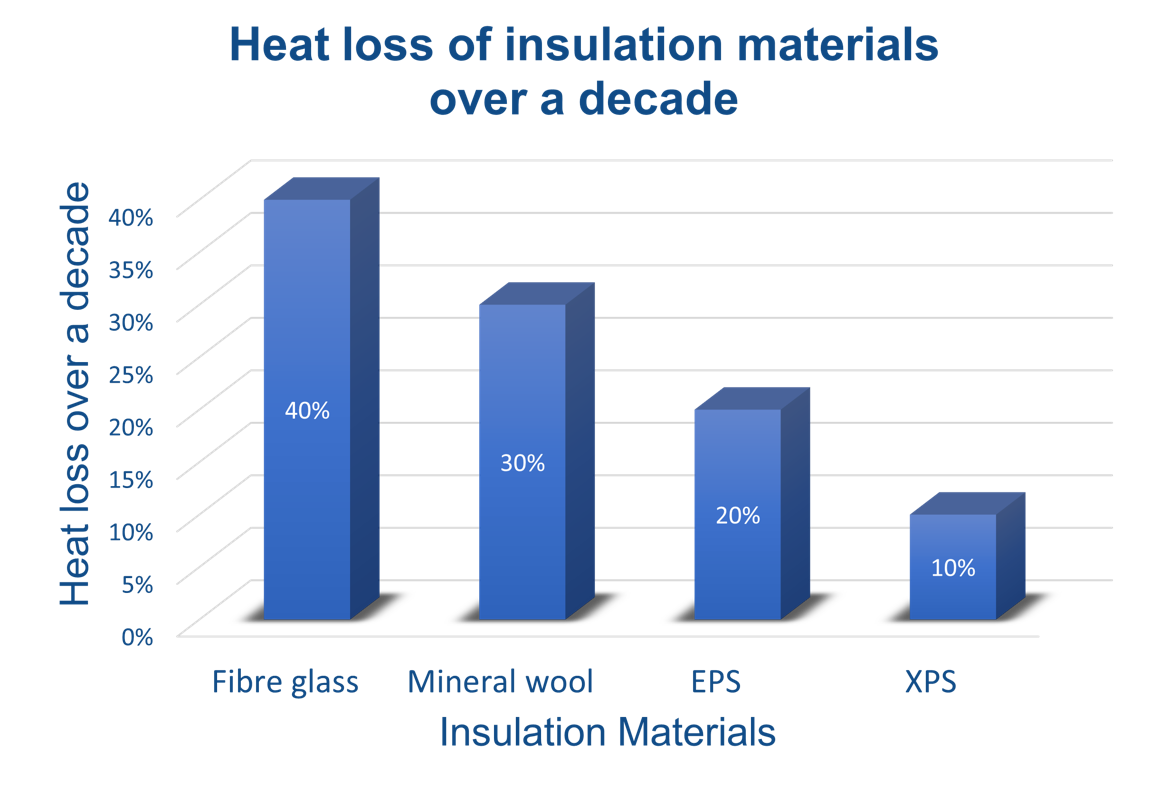
Heat loss of insulation materials over decade
Additionally, spray foam insulation made of polyurethane can help close cracks and stop air leaks, further improving insulation and energy efficiency. By using EPS, XPS, and polyurethane materials for insulation, Canadian homeowners can save on energy expenditures and heating bills while contributing to sustainability goals [1]. By increasing the Thermal Resistance (R-value) and moisture resistance of insulation materials, homeowners can enjoy increased comfort and energy efficiency in both new and old homes.
Overall, using these materials presents a cost-effective and environmentally responsible solution to address the energy waste problem in Canadian homes. By providing superior insulation, the solution helps reduce the carbon footprint of homes across Canada and contributes to a more sustainable future for the country and the world [7].
Introduction of the Four Smart Design Lenses
The present report explores energy waste in Canadian homes through four analytical lenses: (1) the business lens, which considers the economic implications of home insulation and the impact on the construction industry; (2) the human lens, which focuses on the benefits of improving home insulation on homeowners’ health and well-being; (3) the technology lens, which assesses the effectiveness and efficiency of insulation materials and the available technologies for their installation; and (4) the nature lens, which considers the impact of energy waste on the environment and the role of sustainable insulation materials in mitigating this impact. Analyzing the problem through these lenses provides a comprehensive and multifaceted understanding of the issue and proposes a holistic solution.
Smart Design Lenses
Business
The Home Insulation System enhances energy efficiency in buildings at a low cost and eco-friendly approach, aligning with the United Nations (UNs) Sustainable Development Goals(SDGs). With regards to the business component of the intelligent design lenses, seven key considerations should be assessed: a product’s success/failure, the business model, funding sources, revenue/profit projection, implications on local and global business, market potential, material sourcing, and production costs, and value proposition.
Key Metrics for Success/Failure
To assess the success of this design, key metrics include reducing energy consumption and carbon emissions and improving homeowner comfort and cost-effectiveness compared to traditional insulation methods. Scalability and accessibility in the market are also critical factors in evaluating its success. Field tests, customer feedback, and environmental impact assessments will evaluate critical metrics such as energy savings, cost-effectiveness, units sold, customer satisfaction, and environmental impact to determine the project’s success.
Business Model
The proposed business model aims to provide efficient and durable home insulation to Canadian homeowners. The product will be sold through a network of authorized dealers who will be trained to install the insulation system. The business model also includes offering maintenance services to ensure the product’s longevity and effectiveness [8].
Funding Sources and Sustainability
Funding for the Home Insulation System will come from private investors, government grants, and crowdfunding campaigns, with sustainability dependent on the product’s scalability and profitability. Strong partnerships with builders and contractors, ongoing customer support, and continuous product improvement will ensure sustainability and competitiveness in the market.
Revenue/Profit Projection
The proposed home insulation system has the potential to generate substantial revenue and profit by capturing a significant share of the 2.6 billion dollars Canadian insulation industry, which grows at 3.3% annually [9]. Its eco-friendliness and cost savings are key selling points.
Implications on Local, Regional, National and Global Business
The proposed insulation system’s sustainability focus has implications for local and global businesses. Its success will also impact the insulation industry’s competitiveness by offering a cost-effective and environmentally responsible solution.
Market Potential
The proposed product’s superior insulation properties and sustainability focus will give it a competitive edge in the growing market for sustainable products. The project aims to gather customer demand and satisfaction data to assess its potential in meeting the “Government of Canada’s net-zero emissions target by 2050” [10].
Material Sourcing and Production Cost
The proposed insulation system will use readily available EPS and XPS materials. Although the production costs are expected to be higher than traditional methods, the long-term cost-effectiveness makes it a worthy investment for homeowners. Local manufacturers will produce the system, and managing production costs will involve research and development and strong partnerships with suppliers and manufacturers [11].
Value Proposition
Builders find the Home Insulation System an attractive alternative due to its cost-saving, energy-saving, and carbon emission-reduction capabilities. Installation is simple and affordable. The required Relative Strength Index (RSI) values are 7.1-10.6 for roofs/ceilings, 3.9-7.1 for walls, and 4.8-8.8 for floors [12].
Table 1: Recommended minimum insulation values [12]
| House component | Metric (RSI) or imperial | Nominal insulating value | |||
|---|---|---|---|---|---|
| zone A | zone B | zone C | zone D | ||
| Walls | RSI | 3.9 | 4.2 | 4.8 | 7.1 |
| R | 22.0 | 24.0 | 27.0 | 40.0 | |
| Basement walls | RSI | 3.3 | 3.3 | 4.2 | 4.4 |
| R | 19.0 | 19.0 | 24.0 | 25.0 | |
| Roof of ceiling | RSI | 7.1 | 8.8 | 10.6 | 10.6 |
| R | 40.0 | 50.0 | 60.0 | 60.0 | |
| Floor (over unheated spaces) | RSI | 4.8 | 5.5 | 7.1 | 8.8 |
| R | 27.0 | 31.0 | 40.0 | 50.0 | |
Human
Efficient insulation materials such as EPS and XPS can lower heating costs and energy consumption for Canadian homeowners, aligning with the UN’s SDGs. Regarding the human component of the intelligent design lenses, six key considerations should be assessed: access and feasibility, beneficiaries, accountability, impact on stakeholders, and improvement of human life.
Access and Feasibility
The solution includes awareness campaigns, subsidies, and installation training programs to ensure universal access to efficient home insulation. Certified installers are available across Canada, and materials such as EPS and XPS are available. However, lack of awareness, cost, and installation requirements are the main barriers to access. To address these barriers, education and outreach programs can raise awareness about the benefits of these materials and guide their installation and maintenance. Homeowners can also be incentivized to switch to these materials through tax benefits or rebates. EPS has a higher Resistance value (R-value) than fibreglass insulation, at 3.9 per inch [13], making it a more effective insulation option [14].
Table 2: R-Value comparison among different insulating materials [15]
| Insulation | R/inch (@75° F mean) |
|---|---|
| Polyiso board | 5.6 to 6.7 |
| Spray polyurethane foam | 3.6 to 6.7 |
| Extruded polystyrene (XPS) | 5.0 to 5.6 |
| Expanded polystyrene (EPS) | 3.9 to 4.7 |
Beneficiaries
The solution benefits various populations and communities, particularly those residing in colder regions or older homes. For instance, the solution can reduce energy bills and carbon footprint and improve indoor air quality. Moreover, the solution can create job opportunities for installers and contribute to the growth of the green economy.
Accountability
Accountability is shared among manufacturers, installers, government agencies, and homeowners to ensure the Home Insulation System’s success [16]. Quality control measures can certify professionals and ensure high-quality materials, while education and outreach can prevent misuse and promote proper installation and maintenance procedures [17]. Manufacturers must ensure the quality and safety of their products, installers must adhere to industry standards, government agencies must enforce building codes and regulations, and homeowners must maintain their insulation and follow energy-efficient practices [18], [19].
Stakeholders
The stakeholders for this design are manufacturers, installers, government agencies, homeowners, and the environment. Manufacturers have a stake in market demand and product safety, while installers have a stake in reputation and income. Government agencies have a stake in enforcing building codes and regulations [18], [19]. Homeowners have a stake in the financial and environmental benefits of insulation, and the environment has a stake in reducing carbon emissions and conserving natural resources.
Improvement of Human Life
Efficient home insulation can reduce energy bills, improve indoor air quality, and lower the carbon footprint for Canadians [20]. Additionally, it can contribute to the growth of the green economy and create job opportunities for installers.
Technology
Regarding the technology component of the intelligent design lenses, five key considerations should be assessed: proposed technology, modifications, suitability of current technology, infrastructures for technology, and product plan for the extension.
Proposed Technology
The proposed insulation materials are EPS, XPS, PUF, and fibreglass. EPS provides excellent thermal insulation and is lightweight and durable. XPS is moisture-resistant, has stable thermal resistivity, and is recyclable. PUF is famous for thermal insulation due to its low thermal conductivity and outstanding mechanical properties. The thermal resistance of the material is vital when selecting the proper insulation [21].
![Insulating materials: (a) EPS (b) XPS; (c) PUF; and (d) Fibreglass roll sheet [21]](/posts/2023-04-05-efficient-home-insulation/Efficient%20Home%20Insulation/figures/figure%203%20-%20Insulating%20materials%20-%20%28a%29%20EPS%20%28b%29%20XPS%20%28c%29%20PUF%20and%20%28d%29%20Fibreglass%20roll%20sheet.jpg)
Insulating materials: (a) EPS (b) XPS; (c) PUF; and (d) Fibreglass roll sheet [21]
Modifications
The intelligent design approach balances EPS, XPS, and PUF insulation materials. However, it must prioritize sustainable and recycled materials to align with nature. The proposal supports the UN’s SDGs, including “SDG 7 (Affordable and Clean Energy), SDG 11 (Sustainable Cities and Communities), and SDG 12” (Responsible Consumption and Production). Sustainable and recycled materials are utilized in designing the materials to reduce waste and promote responsible production [22]. The materials help reduce energy waste and heating costs, providing affordable and clean energy [1]. The insulation system is a sustainable solution for Canadian homes as they promote sustainable cities and communities.
Suitability of Current Technology
The proposal employs advanced technologies, including EPS, XPS, and PUF insulation materials, surpassing fibreglass, and mineral wool in terms of insulation and resistance to moisture and air leakage. These materials reduce energy waste, lower heating costs, and provide better insulation suitable for the Canadian climate [1].
Infrastructures for Technology
Canadian houses are compatible with the proposed materials. However, material utilization may require improvement due to factors such as material availability, installation costs, and technical skill requirements for installation. A lack of awareness of the solution’s benefits may also challenge its adoption.
Product Plan for Extension
The proposed materials incorporate sustainable and recycled materials, reducing the risk of obsolescence. However, insulation technology advancements may necessitate design adjustments to maintain their effectiveness. Ongoing technical support and training for Canadian homeowners can extend the material’s lifespan to 25 years, surpassing traditional fibreglass insulation, which lasts only 10-15 years. However, regular maintenance is necessary to ensure the material’s longevity.
Nature
The Canadian Home Insulation System prioritizes sustainability, reducing waste output, and lowering energy use and greenhouse gas emissions to enhance air quality and lessen climate change [1], [12], [13]. Regarding the nature component of the intelligent design lenses, four key considerations should be assessed: Impact on the ecosystem, sustainability and environmental impact, projections for improvement to nature, and resource efficiency.
Ecosystem Impact
To minimize the environmental impact of insulation materials during production and disposal, it is crucial to use sustainable insulation materials. Traditional materials like fibreglass and foam insulation can release harmful chemicals during manufacturing [21]. The proposed solution promotes the use of EPS and XPS insulation materials as they are made from recycled materials and have minimal impact on ecosystems.
![The Multiple roles of insulation [23]](/posts/2023-04-05-efficient-home-insulation/Efficient%20Home%20Insulation/figures/figure%204%20-%20The%20Multiple%20roles%20of%20insulation.jpg)
The Multiple roles of insulation [23]
Sustainability and Environmental Impact
To promote sustainability in the production and usage of insulation materials, EPS and XPS are highly recommended. These materials have a low embodied energy, which means they require less energy for production than other materials. They are also durable, long-lasting, and recyclable, reducing waste and environmental impact.
The use of EPS and XPS in home insulation can contribute to the SDGs promoting clean and affordable energy by reducing the energy needed to heat and cool a home. In addition, the recyclability of insulation materials promotes responsible consumption and production (SDG 12) by generating minimal waste during manufacturing. By promoting energy efficiency and reducing energy consumption, home insulation also helps mitigate climate change and contributes to (SDG 13) Climate Action [24].
Projection for Improvement to Nature
EPS and XPS as insulation materials can lower greenhouse gas emissions by reducing the energy needed to “heat and cool homes, improving air quality and reducing pollution” [12], [13]. These materials are also recyclable, promoting sustainability and reducing environmental impact. However, their production requires energy and may contribute to greenhouse gas emissions [12], [13]. Proper recycling is necessary to avoid landfill waste. Despite the materials’ minimal impact on ecosystems, potential negative impacts should be considered.
Resource Efficiency
The sourcing of raw materials for insulation can significantly impact the environment. The production of EPS and XPS requires the use of hydrocarbons, which are sourced from non- renewable sources. However, the use of these materials in efficient home insulation can lead to long-term environmental benefits that outweigh the negative impacts of sourcing raw materials.
Conclusion
The insulation system proposed utilizes EPS and XPS materials to reduce energy waste and provide superior insulation against heat loss. This report analyzes the energy waste problem in Canadian homes through four analytical lenses: business, human, technology, and nature, proposing a holistic solution. By increasing insulation materials’ R-value and moisture resistance, homeowners can enjoy increased comfort and energy efficiency, contributing to sustainability goals. The product’s sustainability focus and superior insulation properties provide a competitive edge in the highly competitive Canadian insulation industry, offering a cost-effective and environmentally responsible solution to address energy waste in Canadian homes.
Presentation
Additional Resources
Sustainable Engineering & Communication Resources
Explore the comprehensive technical reports, presentation slides, and essential engineering communication resources through the repositories below:
Citation
Please cite this work as:
Thakur, Amey. "Efficient Home Insulation". AmeyArc (Apr 2023). https://amey-thakur.github.io/posts/2023-04-05-efficient-home-insulation/.Or use the BibTex citation:
@article{thakur2023efficienthomeinsulation,
  title   = "Efficient Home Insulation",
  author  = "Thakur, Amey",
  journal = "amey-thakur.github.io",
  year    = "2023",
  month   = "Apr",
  url     = "https://amey-thakur.github.io/posts/2023-04-05-efficient-home-insulation/"
}